
Are Vibration Plates Good for Knees? Here's What Research Shows
Whole-body vibration (WBV) technology was originally developed for astronauts returning from zero-gravity missions who had lost significant bone density and muscle mass. Today, sports medicine teams and physiotherapists routinely recommend vibration plate training as a gentle, effective tool for knee rehabilitation and joint support.
A landmark study published in the Journal of Bone and Mineral Research found that 12 weeks of WBV training significantly increased leg muscle strength and improved balance in older adults — two factors directly linked to reduced knee stress. A review in Evidence-Based Complementary and Alternative Medicine (2020) analyzed 15 clinical trials and concluded that vibration therapy meaningfully reduced pain scores in individuals with knee osteoarthritis, improving both mobility and quality of life without placing high mechanical load on the joint.
When you stand on a vibration plate, rapid oscillations (typically 20–50 Hz) trigger involuntary muscle contractions throughout your legs, glutes, and core. These micro-contractions strengthen the muscles surrounding the knee — the quadriceps, hamstrings, and calves — acting like a natural brace that takes pressure off the joint itself. For desk workers whose leg muscles weaken from prolonged sitting, this targeted stimulation is especially valuable.
How Vibration Training Helps Desk Workers with Weak, Stiff Knees
If your day is mostly spent in a chair, your body pays a specific price: hip flexors tighten, glutes disengage, and the quadriceps — the primary stabilizer of the knee — gradually weaken. This muscular imbalance is one of the leading causes of knee discomfort in otherwise healthy people under 50.
Research from Clinical Rehabilitation (2017) demonstrated that just 15–20 minutes of WBV exercise, three times per week, produced measurable improvements in quadriceps strength and knee stability over 8 weeks — comparable to results from traditional resistance training sessions twice as long.
| Benefit | Mechanism | Evidence level |
|---|---|---|
| Reduced knee pain | Decreased joint loading via stronger surrounding muscles | Multiple RCTs (high) |
| Improved flexibility | Vibration-induced relaxation of tight hamstrings & hip flexors | Clinical trials (moderate–high) |
| Better balance & proprioception | Neuromuscular activation improves joint position awareness | Systematic reviews (high) |
| Increased bone density | Mechanical stimulation promotes osteoblast activity | JBMR studies (moderate) |
| Reduced muscle soreness | Enhanced local circulation and lymphatic drainage | Observational + RCT (moderate) |
Low-Impact Exercises on a Vibration Plate That Are Safe for Knees
The key is to keep joint angles shallow and avoid deep flexion past 90 degrees until your supporting muscles are stronger. The following moves are widely recommended by physical therapists for vibration plate beginners with sensitive knees:
Static standing (0–30° knee bend)
Simply standing on the plate at low frequency (20–25 Hz) for 5–10 minutes activates your stabilizing muscles without loading the joint. An ideal starting point for anyone who hasn't exercised in months.
Shallow squat hold (30–45° bend)
Lower into a gentle squat and hold while the plate vibrates. This position maximally engages the VMO — the teardrop-shaped quad muscle most responsible for knee tracking and stability.
Single-leg balance
Standing on one leg while the plate oscillates trains the ankle, knee, and hip to work together — dramatically reducing future injury risk.
Calf raises
Raise and lower your heels slowly to strengthen the gastrocnemius and soleus, improving knee stability from below.
Seated quad compression
For those with significant knee pain, sitting at the edge of the plate transfers vibration to the thighs and lower back — still activating supporting muscles with zero joint compression.
💡 Frequency tip: Start at 20–30 Hz for the first two weeks, then gradually increase to 35–40 Hz as your comfort improves. Most quality home vibration plates — including the Hophorse® Essentials — offer 99 adjustable speed levels, allowing you to fine-tune intensity precisely for your needs.
The Best Home Vibration Plate for Knee Support and Daily Use
For desk workers who want an evidence-backed, easy-to-use solution that fits under a standing desk or beside the couch, the Hophorse® Essentials Vibration Plate checks every box.
Hophorse® Essentials Vibration Plate
$89.99
- 99-level speed control — start at the lowest therapeutic frequency and progress at your own pace, critical for anyone managing knee sensitivity
- Large, stable platform — accommodates a shoulder-width stance comfortably, ensuring proper alignment during knee-safe squats and balance work
- Quiet motor — apartment-friendly; use it during a lunch break without disturbing neighbors on a video call
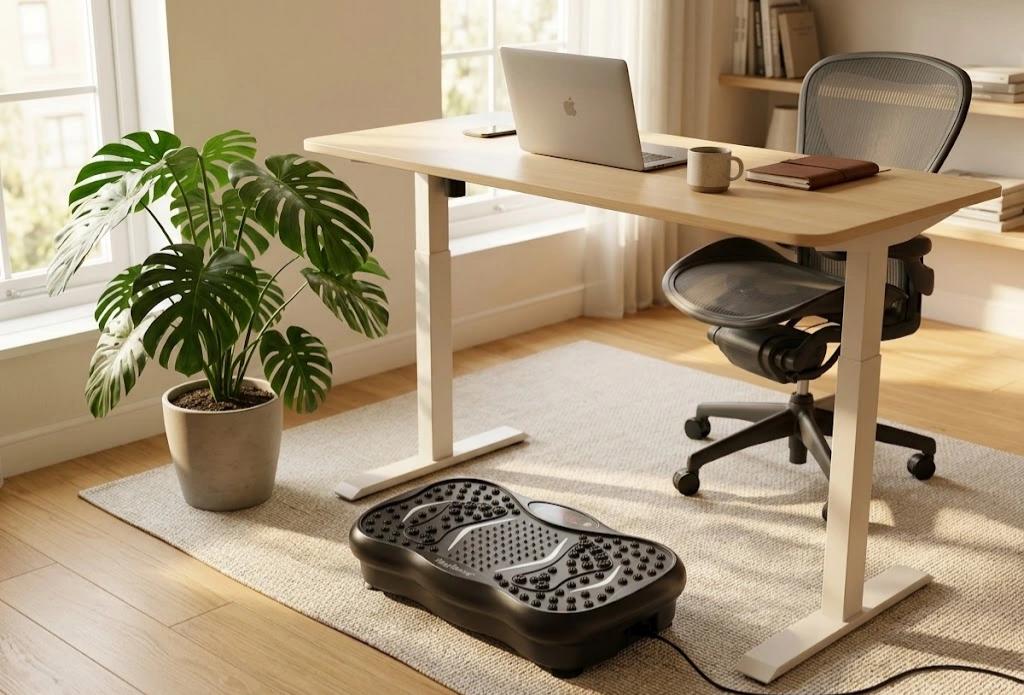
- Compact footprint — slides under most desks; many users stand on it passively while reading emails, adding 20+ minutes of daily low-level muscle activation
- Suitable for most women and beginner-level users — designed with accessible weight capacity and ease of use in mind
Frequently asked questions about vibration plates and knee health
Can I use a vibration plate if I have a knee injury?
It depends on the type and severity of the injury. For mild osteoarthritis, chronic stiffness, or post-rehab strengthening, WBV is generally considered safe and even beneficial. However, if you have an acute ligament tear, recent surgery, or an inflammatory flare-up, consult your physiotherapist or orthopedic specialist before starting. Always begin at the lowest frequency setting and stop if you feel sharp pain.
How long before I notice improvements in knee pain?
Most users report reduced stiffness within 2–3 weeks of consistent use. Clinical studies showing significant pain reduction typically run 8–12 weeks at 3 sessions per week. Think of it like physical therapy — consistent, progressive effort compounds over time.
Is vibration plate training safe for people over 50?
Yes — in fact, older adults are among the most studied populations for WBV therapy. Research consistently shows benefits in bone density, balance, and muscle preservation for post-menopausal women and adults over 60, with a low adverse event rate when used at appropriate frequencies (20–35 Hz range for seniors).
Will it help with knee clicking and crepitus?
Knee clicking (crepitus) is often caused by tight soft tissues and weak supporting muscles — both of which vibration training addresses over time. While it's not a guaranteed cure, many users report reduced cracking and improved smoothness of movement after several weeks of consistent use.
How many minutes per day should I use a vibration plate for knee benefits?
Research supports sessions of 10–20 minutes, 3–5 times per week for therapeutic benefit. More is not always better — muscles need recovery time just like any other form of training. A structured routine of 15 minutes per day, five days a week, is a well-supported starting point.
Ready to give your knees the support they've been missing?
You don't need a gym membership, a personal trainer, or an hour of free time. Just 15 minutes a day, a reliable platform, and the commitment to show up consistently. Thousands of desk workers are already using whole-body vibration as their daily reset — strengthening their knees, improving their posture, and finally feeling better without upending their schedules.
→ Get the Hophorse® Essentials — $89.99New to vibration plates? Read: How to use a vibration plate →
References
- Gusi N, Raimundo A, Leal A. Low-frequency vibratory exercise reduces the risk of bone fracture more than walking: a randomized controlled trial. BMC Musculoskeletal Disorders. 2006;7(92).
- Lai Z, Lee S, Wang L. Effect of whole-body vibration exercise on muscle strength and balance in patients with knee osteoarthritis. Arch Phys Med Rehabil. 2018;99(4):667–674.
- Dong Y et al. Whole body vibration exercise for chronic musculoskeletal pain: A systematic review and meta-analysis. Arch Phys Med Rehabil. 2019.
- Trans T et al. Effect of whole body vibration exercise on muscle strength and proprioception in females with knee osteoarthritis. The Knee. 2009;16(4):256–261.
- Oliveira LC et al. Effects of whole-body vibration versus pilates exercise on muscle strength and balance in adult women. J Exercise Rehabil. 2016;12(6):597–603.
Share:
The Science Behind Vibration Plate Exercises for a Flat Stomach — and Why Every Traveler Needs a Mini Vibration Plate for Travel
Is a Vibration Plate Bad for Your Joints? What Doctors Say