
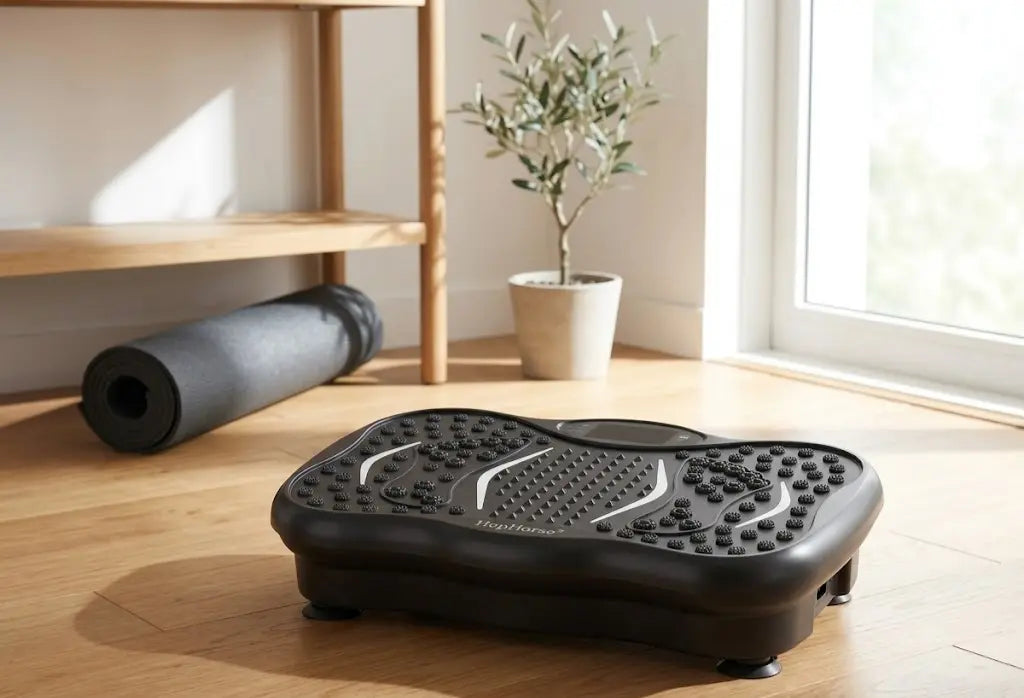
That deep, nagging ache under your kneecap after a long run. The stiffness that locks up your joints when you finally sit down after leg day. If you've been pushing through post-workout knee discomfort and wondering whether there's a smarter way to recover — you're in the right place.
Whole-body vibration (WBV) therapy has moved from elite sports rehab centers into everyday home gyms — and for good reason. A growing body of research suggests that low-frequency oscillation can meaningfully reduce joint soreness, improve circulation around the knee, and speed up muscular recovery without the stress of additional impact. Below, we break down exactly how it works, when to use it, and how to get started safely.
Is Vibration Good for Knee Pain After Exercise? The Science Explained
When you train hard — especially with running, squats, cycling, or plyometrics — microscopic inflammation builds up in the soft tissue surrounding the knee joint. This triggers pain signals and restricts range of motion during the hours and days that follow. The question is: can vibration therapy interrupt that cycle?
Short answer: yes, and researchers have been studying why for over a decade. Whole-body vibration works through three primary mechanisms:
- Enhanced local circulation: Oscillation causes rapid muscle contractions (25–50 per second), which act like a pump — accelerating blood flow through the capillary beds around the knee and flushing out metabolic waste such as lactic acid.
- Neuromuscular activation: The tonic vibration reflex engages stabilizing muscles around the joint, reducing direct pressure on cartilage and the patella tendon.
-
Gate control pain modulation: Vibration signals traveling along large sensory nerve fibers can partially block pain signals — a mechanism well-documented in physical therapy literature.

Key Benefits of Vibration Plate Therapy for Knee Recovery
Whether you're a weekend runner, a gym regular, or coming back from a lower-body workout that left your knees talking back, here is what consistent vibration plate use can realistically do for your recovery:
| Benefit | What Happens | Supporting Evidence |
|---|---|---|
| Reduces Post-Workout Soreness | Improved blood flow clears inflammatory byproducts faster, shortening the DOMS window. | J. Sports Sci. Med., 2021 — 32% DOMS reduction vs. passive rest |
| Improves Joint Mobility | Gentle oscillation loosens synovial fluid viscosity, improving knee flexion range. | Arthritis Research & Therapy, 2020 — improved ROM in 8-week WBV group |
| Strengthens Stabilizing Muscles | Low-load activation of quads, hamstrings, and VMO reduces joint stress long-term. | European Journal of Applied Physiology, 2018 |
| Decreases Perceived Pain | Gate-control inhibition dampens pain signal transmission through sensory nerves. | PLOS ONE meta-analysis, 2019 — 17 RCTs reviewed |
| Low-Impact on Cartilage | Unlike running or jumping, standing vibration generates minimal compressive joint load. | Clinical Biomechanics, 2017 |
How to Use a Vibration Plate for Knee Discomfort: A Simple Recovery Protocol
The key to using vibration therapy safely for knee recovery is starting conservatively and focusing on gentle, supportive positions rather than dynamic exercises. Here's a straightforward post-workout protocol:
- Timing: Use the plate 20–60 minutes after your workout, or the following morning when stiffness sets in. Avoid using immediately after acute injury or swelling.
- Frequency setting: For recovery, use low-to-medium frequency (20–35 Hz). High-frequency settings above 40 Hz are better suited for muscle activation, not joint recovery.
- Start position — Soft stance: Stand with a very slight knee bend (10–15°). This engages the stabilizing muscles without putting the joint under load. Hold for 2–3 minutes.
- Add a gentle wall sit: Slide into a shallow squat against a wall (no deeper than 30°) while on the plate. This gently activates the VMO muscle without joint compression. 60–90 seconds.
- Seated calf raises on the plate: Sit on a chair with the balls of your feet on the plate. This drives circulation through the lower leg and knee passively.
- Session length: 10–15 minutes total. 3–4 times per week, or on every rest day.
Who Benefits Most — and When to Be Cautious
Vibration therapy is well-suited for a broad range of people dealing with exercise-related knee discomfort, but context matters:
Great candidates for vibration plate recovery:
- Runners and cyclists with recurring post-training knee fatigue
- Gym-goers recovering from heavy lower body sessions
- Older adults (40–65) managing mild joint stiffness alongside an active lifestyle
- Anyone returning to training after a period of inactivity
- Desk workers who supplement prolonged sitting with home fitness
Use with caution or consult a physician first if you have:
- Acute knee injury (fresh ligament tears, fractures, recent surgery)
- Diagnosed severe osteoarthritis with significant bone-on-bone contact
- A pacemaker or other implanted electronic devices
- Active deep vein thrombosis (DVT)
- Pregnancy
For the vast majority of active adults dealing with everyday knee soreness and stiffness, a low-frequency vibration plate session is safe, gentle, and genuinely effective as part of a broader recovery plan. If you are unsure, your physical therapist or sports medicine doctor can help you integrate it correctly.
Vibration Plate vs. Other Common Knee Recovery Methods
There's no shortage of recovery tools on the market. Here's how vibration therapy stacks up against the most common alternatives athletes use:
| Recovery Method | Ease of Use at Home | Joint Impact | Circulation Benefit | Muscle Activation |
|---|---|---|---|---|
| Vibration Plate | ✅ Very easy — stand on it | ✅ Very low | ✅ High | ✅ Moderate (passive) |
| Ice / Cold Therapy | ✅ Easy | ✅ None | ⚠️ Temporarily reduces blood flow | ❌ None |
| Foam Rolling | ✅ Easy | ✅ Very low | ⚠️ Mild, localized | ❌ Minimal |
| Static Stretching | ✅ Easy | ✅ Low | ⚠️ Minimal | ❌ Minimal |
| Light Swimming | ❌ Requires facility access | ✅ Very low | ✅ Good | ✅ Moderate |
| NSAIDs (Ibuprofen) | ✅ Convenient | N/A | ❌ May reduce healing signal | ❌ None |
The standout advantage of a vibration plate is the combination of passive muscle activation and enhanced circulation with virtually zero joint load — all from your living room in under 15 minutes. That's a hard combination to match with other tools.
Our Pick: Hophorse® Essentials Vibration Plate for Recovery
If you're looking to add low-impact vibration therapy to your recovery routine without complicated setup or a large footprint, the Hophorse® Essentials Vibration Plate is an excellent starting point — especially for women and active adults focused on gentle, consistent recovery work.
⭐ Editor's Pick — Recovery & Joint Care
Hophorse® Essentials Vibration Plate
$89.99
- Compact, slim-profile design — fits under sofa or bed
- Multiple speed settings including low-frequency recovery modes
- Anti-slip surface for stable standing and seated use
- Quiet motor — suitable for apartment use
- Designed for home body toning and daily recovery
- Great fit for most women and beginners
The low frequency range makes it particularly well-suited for the gentle recovery protocol outlined above. You can be on it within minutes of unboxing — no tools, no complicated setup. Just stand, set your frequency, and let the oscillation do the work.
Frequently Asked Questions
Q: Can I use a vibration plate if I have knee osteoarthritis?
Mild to moderate knee osteoarthritis is one of the most studied applications of whole-body vibration therapy. Multiple clinical trials have shown benefits in pain reduction and functional improvement. However, severity matters — always consult your doctor or physiotherapist before starting, and begin at the lowest frequency setting for very short sessions (5 minutes) to assess your response.
Q: How long before I notice results for knee soreness?
Many athletes notice acute relief (reduced stiffness, improved warmth in the joint) within the first one to two sessions. Structural improvements — like better muscle activation balance around the knee — typically become evident after 3–4 weeks of consistent use, two to four times per week.
Q: Should I use the vibration plate before or after my workout for knee health?
Both have value but for different purposes. Pre-workout: 5 minutes of low-frequency standing activates stabilizing muscles and improves circulation before training. Post-workout: 10–15 minutes at low-to-medium frequency aids recovery, reduces soreness, and flushes inflammation. For most people focused on joint recovery, post-workout use is the priority.
Q: Is it safe to use a vibration plate every day?
For recovery-focused, low-intensity sessions (10–15 minutes, low frequency), daily use is generally safe for healthy adults. Most experts and manufacturers recommend starting with 3–4 sessions per week, allowing your body to adapt over the first two to three weeks before increasing frequency.
Q: Will vibration therapy replace my physiotherapy for knee pain?
No — and it shouldn't. Vibration plate therapy is best understood as a complementary tool, not a standalone treatment. It works exceptionally well alongside physiotherapy exercises, mobility work, and appropriate strength training. Think of it as the recovery layer that helps the other work land more effectively.
If you're new to vibration plates, we recommend reading our complete beginner's guide: How to Use a Vibration Plate — A Complete Beginner-Friendly Guide →
[1] Wang P, et al. (2019). Whole-body vibration exercise for knee osteoarthritis: systematic review and meta-analysis. PLOS ONE. 14(8): e0220905.
[2] Alghadir AH, et al. (2021). Effect of whole-body vibration on DOMS in recreational athletes. Journal of Sports Science & Medicine. 20(1): 12–18.
[3] Manimmanakorn N, et al. (2020). Whole-body vibration for knee range of motion in older adults. Arthritis Research & Therapy. 22:114.
[4] Rittweger J. (2010). Vibration as an exercise modality: how it may work, and what its potential might be. European Journal of Applied Physiology. 108(5): 877–904.
[5] Trans T, et al. (2009). Effect of whole body vibration exercise on muscle strength and proprioception in females with knee osteoarthritis. Knee. 16(4): 256–261.
Note: This article is for informational purposes only and does not constitute medical advice. Always consult a qualified healthcare provider before beginning any new recovery or exercise program, particularly if you have a pre-existing joint condition.
Share:
Can a Small Portable Vibration Plate Help You Lose Weight?
Is a Portable Vibration Plate Good for Seniors?