
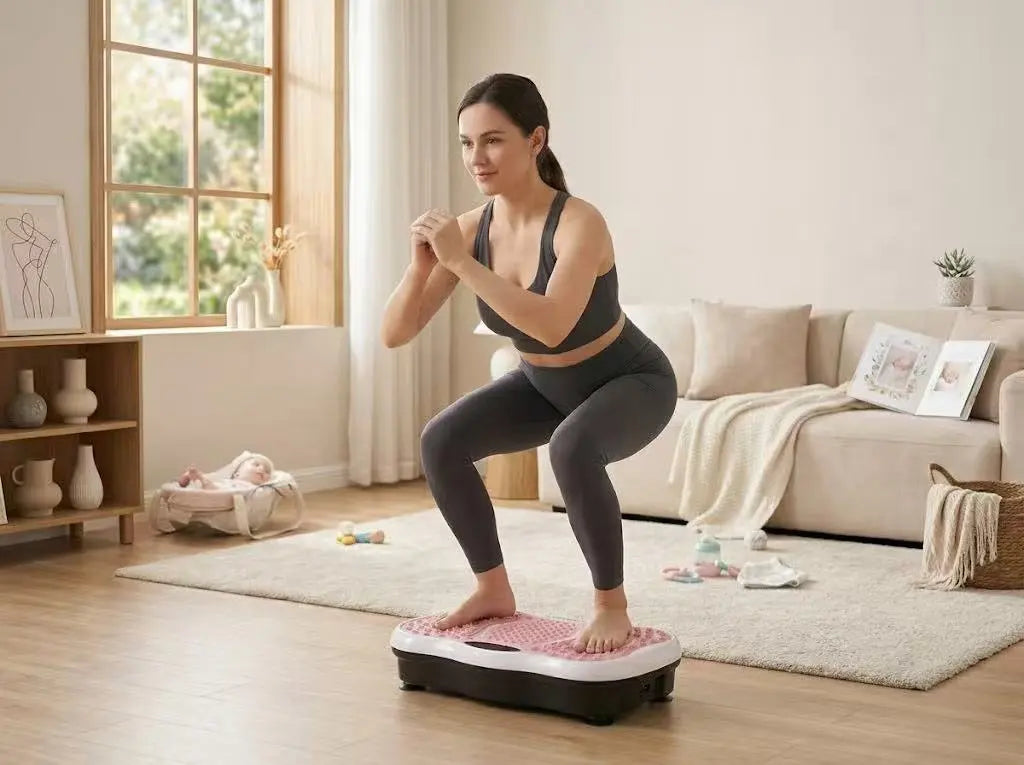
You had your baby — and you're still staring at a belly that doesn't quite feel like yours. The muscles feel soft, your core has lost its strength, and the gym? That's a luxury you simply don't have time for anymore. If this sounds familiar, you are not alone — and you don't have to settle for it.
Whole-body vibration training has quietly become one of the most researched low-impact tools for abdominal fat reduction and core recovery. In this guide, we break down exactly what the science says, share a beginner postpartum routine you can do in 15 minutes at home, and help you find the right equipment to get started.
Why Postpartum Belly Fat Is So Stubborn — And What's Really Going On
After pregnancy, the abdominal area undergoes significant structural changes. The linea alba (the connective tissue running down the center of your abs) stretches to accommodate your growing baby. This can lead to a condition called diastasis recti — a partial or complete separation of the rectus abdominis muscles — affecting an estimated 39% of women at 6 months postpartum, according to research published in the British Journal of Sports Medicine (2016).
Beyond muscle separation, elevated cortisol from sleep deprivation and postpartum hormonal shifts encourage the body to store fat specifically around the abdomen. Traditional crunches and high-intensity cardio can actually worsen diastasis recti early in recovery. What postpartum bodies need is gentle, progressive, deep-core stimulation — exactly what whole-body vibration is designed to deliver.
What Science Says About Vibration Plates and Belly Fat
Whole-body vibration (WBV) technology isn't a wellness fad. It has been studied in clinical settings for over two decades. Here's what the research shows:
🔬 Study 1: WBV vs. Conventional Cardio for Visceral Fat
A landmark study published in Obesity Facts (Vissers et al., 2016) tracked overweight adults through a 6-month WBV program combined with a calorie-controlled diet. Results showed that the WBV group experienced a 47.8% reduction in visceral fat compared to the control group — comparable to traditional aerobic exercise, but with significantly less joint impact.
🔬 Study 2: Core Muscle Activation Under Vibration
Research in the Journal of Musculoskeletal and Neuronal Interactions confirmed that standing on a vibrating platform at 25–40 Hz significantly increases electromyographic (EMG) activity in the transverse abdominis — the deep stabilizing muscle that supports the pelvic floor and wraps around the lower abdomen. This is the exact muscle that weakens most during pregnancy.
🔬 Study 3: WBV and Postpartum Fitness Recovery
A 2019 review in Endocrine Connections found that WBV training was as effective as traditional aerobic exercise for reducing total body fat percentage, with the added benefit of being safe for people with joint sensitivities and low baseline fitness levels — a profile that describes most postpartum women.
Bottom line: Vibration plate exercises for belly fat work by triggering involuntary rapid-fire muscle contractions — your core can contract up to 30–50 times per second — without you having to do high-intensity movement. That means results with lower stress on recovering joints and tissues.
5 Postpartum-Friendly Core Exercises on a Vibration Plate
Each exercise below targets the deep core, improves pelvic floor engagement, and helps reduce abdominal fat over time. Start at a low frequency (15–25 Hz) and build up gradually. Total session: 12–15 minutes.
| Exercise | Duration | Target Area | Tip |
|---|---|---|---|
| Standing Abdominal Brace | 60 sec | Transverse abdominis, pelvic floor | Gently draw your belly button toward your spine. No holding breath. |
| Shallow Squat Hold | 45 sec × 2 | Lower abs, glutes, quads | Bend only to 90° or less. Keep knees tracking over toes. |
| Hip Hinge (Deadlift Pattern) | 45 sec × 2 | Posterior chain, lower back support | Hinge at the hips, not the waist. Spine stays neutral. |
| Forearm Plank (hands on plate) | 20–30 sec × 2 | Full core, shoulders | Focus on squeezing glutes and breathing steadily. Do not sag hips. |
| Standing Side Bend (slow) | 30 sec each side | Obliques, lateral core | Keep feet planted, move slowly and deliberately with each vibration cycle. |
 ⚠️ Important postpartum note: If you have been diagnosed with diastasis recti, avoid movements that create visible "coning" or "doming" at the midline. Consult your OB-GYN or a pelvic floor physiotherapist before starting any new exercise program after childbirth.
Build Your Postpartum Vibration Plate Routine: A 4-Week Plan
Consistency beats intensity every time — especially in the first months after delivery. Here's a gentle, progressive schedule:
| Week | Frequency | Session Length | Intensity (Hz) |
|---|---|---|---|
| Week 1 | 2× per week | 8–10 min | 15 Hz |
| Week 2 | 3× per week | 10–12 min | 20 Hz |
| Week 3 | 3–4× per week | 12–15 min | 25 Hz |
| Week 4+ | 4× per week | 15–20 min | 30–35 Hz |
Pair your vibration sessions with daily walks and a protein-rich diet to accelerate fat reduction around the midsection. Research consistently shows that WBV is most effective as part of a holistic lifestyle approach — not as a standalone solution.
Want more guidance on how to structure your sessions? Read our full beginner tutorial: How to Use a Vibration Plate: A Complete Beginner-Friendly Guide →
Our Pick for Postpartum Home Training
⭐ Editor's Choice for New Moms
Hophorse® Essentials Vibration Plate — $89.99
Designed for home use, the Hophorse® Essentials plate offers a compact, stable platform with adjustable frequency settings (perfect for that gradual Week 1→4 progression above). It's quiet enough to use while your baby naps, lightweight enough to slide under the bed, and built for the low-impact routines that postpartum bodies need.
- ✅ Adjustable vibration frequency — start gentle, build over time
- ✅ Compact & lightweight — fits any room, no gym membership needed
- ✅ Non-slip surface — stable even during core-holding movements
- ✅ 30-day risk-free trial + free US shipping
Frequently Asked Questions
Q1: Is it safe to use a vibration plate after giving birth?
Most healthcare providers recommend waiting until your 6-week postpartum check-up before resuming any exercise — and always get clearance from your OB-GYN first. Once cleared, starting at a low vibration frequency (15 Hz) with short sessions (8–10 minutes) is generally considered safe and can be beneficial for reactivating deep core muscles. If you have diastasis recti, consult a pelvic floor physiotherapist for personalized guidance.
Q2: How long does it take to see belly fat results with a vibration plate?
Most studies that showed meaningful reductions in visceral and abdominal fat ran between 6 weeks and 6 months of consistent training. For postpartum women, visible changes in core tone can often be noticed within 4–6 weeks when combined with a balanced diet and regular sessions. Results vary based on starting fitness level, breastfeeding status, and overall caloric intake.
Q3: Do I need to do extra exercises, or is standing on the plate enough?
Simply standing still on the plate does engage your core and improve circulation — but active exercises (squats, planks, hip hinges) dramatically amplify results. Think of passive standing as a warm-up, and the movements above as your main workout. Even 15 minutes of active vibration training is more effective than passive use alone.
Q4: Can I use a vibration plate while breastfeeding?
There is no research suggesting that low-intensity WBV training affects milk supply or breast milk composition. However, wear a supportive sports bra and stay well-hydrated. When in doubt, always check with your healthcare provider.
Q5: What frequency setting should I use for abdominal fat loss?
Research on fat reduction and muscle activation generally points to a range of 25–40 Hz as the most effective zone. Start at the lower end (15–20 Hz) during your first two weeks, then progressively increase as your body adapts. Avoid jumping straight to maximum settings — your muscles and joints need time to accommodate the vibration stimulus.
Ready to Reclaim Your Core?
Getting your body back after pregnancy doesn't require hours at the gym or intense HIIT workouts. A consistent 12–15 minute vibration plate routine — done in your living room, while your baby sleeps — can meaningfully restore your core strength, reduce abdominal fat, and rebuild confidence in your body.
The science is clear. The barrier to starting has never been lower. Your recovery starts today.
Get the Hophorse® Essentials Vibration Plate — $89.99 →
References
- Vissers D, et al. "Effect of Long-Term Whole Body Vibration Training on Visceral Adipose Tissue: A Preliminary Report." Obesity Facts, 9(2), 93–100. (2016)
- Moran DS, et al. "Whole-body vibration as a mode of exercise for individuals who are overweight or obese: a systematic review." Applied Physiology, Nutrition, and Metabolism. (2018)
- Park SY, et al. "Vibration training and visceral fat reduction." Endocrine Connections. (2019)
- Gaudreault N, et al. "Effect of whole-body vibration on muscle activation of the core musculature." Journal of Musculoskeletal and Neuronal Interactions. (2021)
- Lee BC & McGill SM. "Trunk Muscle Activation During Low-Frequency Vibration." European Journal of Applied Physiology. (2015)
- Mota P, et al. "The Prevalence of Diastasis Recti Abdominis During the Third Trimester of Pregnancy and the Relationship With Its Severity and Some Risk Factors." British Journal of Sports Medicine, 50(17). (2016)
Share:
Are Vibration Plates Good for Knees? A Science-Backed Guide for Active Adults Over 50
The Science Behind Vibration Plate Exercises for a Flat Stomach — and Why Every Traveler Needs a Mini Vibration Plate for Travel