
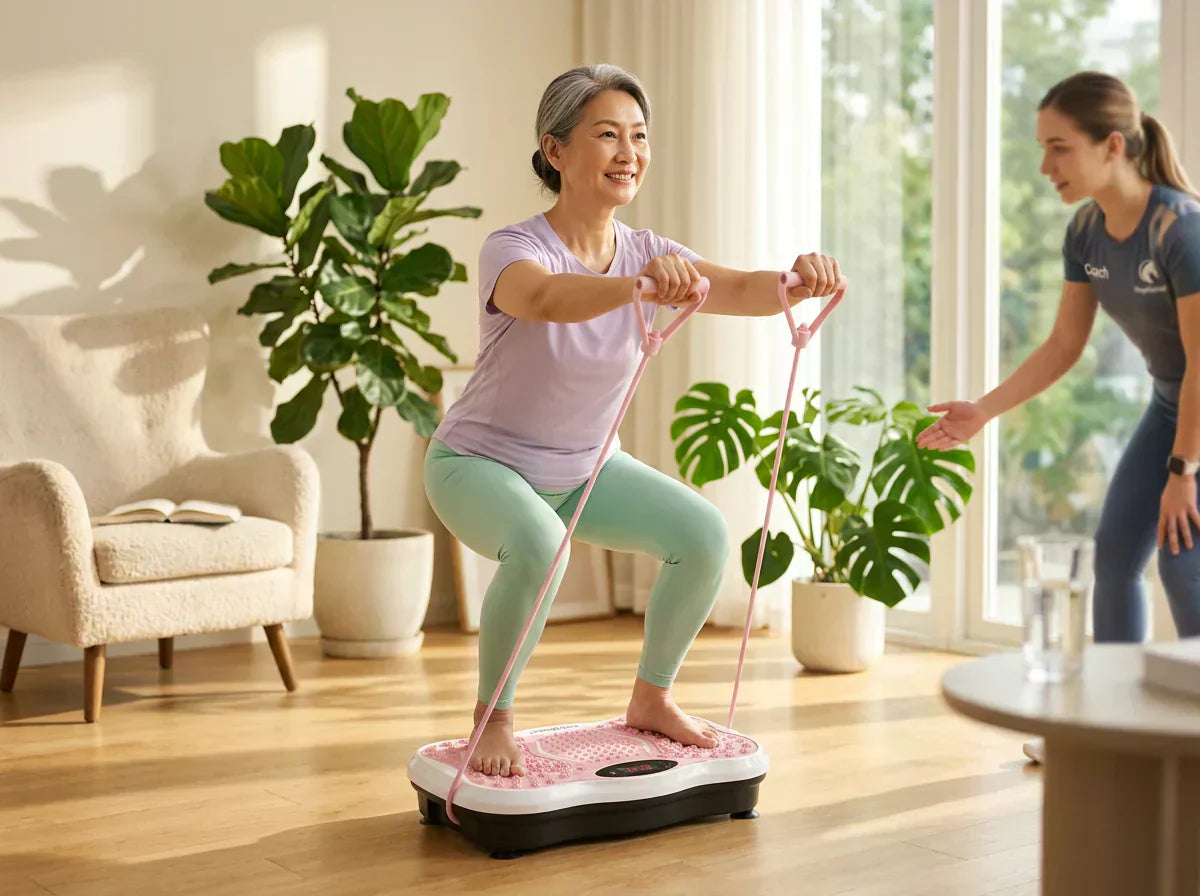
Every step feels like a negotiation. You want to stay active, keep your weight in check, and protect your independence — but your knees have other plans. If that sounds familiar, you're not alone. Millions of adults over 50 are quietly sidelined by knee discomfort every day. Here's what most people don't know: a vibration plate for bad knees may be one of the gentlest, most effective tools available to help you move again — without the joint strain of traditional exercise.
This guide breaks down exactly how whole-body vibration works, what exercises are safe for sensitive knees, what features to look for in a machine, and which model our team recommends for everyday senior wellness. No hype — just practical, evidence-backed information.
Why Knee Discomfort Makes Traditional Exercise So Difficult
Knee pain is among the most common complaints in adults aged 50 and older. According to the Annals of Internal Medicine, roughly one in four adults reports significant knee pain, and the prevalence rises sharply with age. The underlying causes vary — osteoarthritis, bursitis, weakened cartilage — but the shared consequence is the same: high-impact activities like running, jumping, and heavy squats become painful or impossible.
Yet inactivity creates its own problems. Weak quadriceps and hamstrings offer less support to the knee joint, accelerating cartilage wear. Excess body weight increases compressive forces on the knee with every step. The result is a frustrating cycle: the more it hurts, the less you move; the less you move, the more it hurts.
Low-impact alternatives — swimming, cycling, tai chi — are often recommended, but they require gear, pools, or substantial coordination. That's where a knee-friendly vibration platform offers a meaningful advantage: it delivers measurable muscle stimulation with minimal joint compression, right in your living room.
The Science of Using a Vibration Plate for Bad Knees
A vibration plate works through a principle called tonic vibration reflex (TVR). When the platform oscillates — typically between 20 and 50 Hz — your muscles respond with thousands of rapid, involuntary micro-contractions per minute. This neurological response activates deep stabilizing muscles around the knee, hip, and core without requiring heavy loads or repetitive impact.
This matters for joint health for three key reasons:
- Reduced Axial Load: Because you're standing (or seated) rather than jumping or lunging, compressive forces through the knee remain low — comparable to slow walking, far less than jogging.
- Improved Circulation: The rapid oscillation promotes blood flow to cartilage and soft tissue, which receive poor vascular supply naturally. Enhanced circulation may aid recovery and reduce stiffness.
- Proprioceptive Training: Studies published in the Journal of Aging and Physical Activity show that vibration platforms measurably improve proprioception — the body's ability to sense its own position — which is a critical factor in fall prevention among older adults.
A 2020 randomized controlled trial in Clinical Rehabilitation found that eight weeks of whole-body vibration training improved knee extensor strength by an average of 18% in adults over 60 with mild-to-moderate osteoarthritis — without medication changes or additional physical therapy.
5 Gentle Vibration Plate Exercises Safe for Sensitive Knees
Not every exercise is appropriate for aching joints. The following movements are specifically chosen for their low joint-loading profile. Always begin at the lowest vibration frequency (20–25 Hz) and limit sessions to 10–15 minutes until your body adapts.
1. Static Standing (Beginner Foundation)
Stand with feet hip-width apart, knees very slightly bent (never locked). Keep your weight balanced and your core lightly engaged. This alone activates stabilizing muscles across the hip, quad, and calf. Start here: 2 minutes on, 1 minute rest.
2. Partial Knee Bend (Mini Squat)
Lower into a gentle bend of no more than 20–30 degrees — think "beginning to sit" rather than a full squat. Hold for 20–30 seconds. This range avoids peak patellofemoral stress while building quadriceps endurance. Use a wall or railing for balance if needed.
3. Seated Calf Raise
Sit on a sturdy chair placed directly in front of the platform with both feet flat on the vibrating surface. Slowly raise your heels, hold 2 seconds, lower. This targets the calf and soleus without any knee flexion stress — excellent for those with severe joint sensitivity.
4. Hip Hinge Stretch
Stand on the platform, hinge forward at the hips (not the waist) to a comfortable angle, and hold a light stretch through your hamstrings. The vibration enhances tissue pliability and may help reduce morning stiffness that many knee-pain sufferers experience.
5. Single-Leg Balance Hold
Once comfortable with the platform, try placing one foot on the surface and the other slightly lifted. Hold 15–20 seconds each side. This is a powerful proprioception drill shown to reduce fall risk in community-dwelling older adults (Cochrane Review, 2019).
Key Features to Look for in a Knee-Friendly Vibration Machine
Not all oscillating platforms are built equally. When choosing a machine for joint-conscious exercise, the following specs matter most:
| Feature | Why It Matters for Knee Comfort | Ideal Spec |
|---|---|---|
| Frequency Range | Lower frequencies (15–30 Hz) are gentler; higher settings may aggravate inflamed tissue | 15–50 Hz adjustable |
| Amplitude (Vibration Depth) | Low amplitude (2–4 mm) reduces joint stress vs. aggressive high-amplitude units | ≤ 5 mm for beginners |
| Non-Slip Surface | Prevents foot slippage, which can create sudden torque through the knee | Textured rubber mat |
| Stable Platform Size | A wider deck allows a comfortable, natural foot stance without inward knee tracking | ≥ 24 × 14 inches |
| Support Handle / Resistance Bands | Assists balance so weight stays centered; reduces fall risk for seniors | Included or compatible |
| Weight Capacity | A higher capacity often indicates a sturdier, less-vibrating frame — more stable underfoot | ≥ 265 lbs |
Our Top Recommendation: The Hophorse® Essentials Vibration Plate
After evaluating the features that matter most for joint-conscious exercise, one model consistently stands out for everyday senior use: the Hophorse® Essentials Vibration Plate. Designed with accessibility and daily usability in mind, it hits the practical requirements without unnecessary complexity.
The approachable, joint-friendly choice for women and older adults beginning a low-impact wellness routine.
- ✅ Adjustable frequency settings — start low, progress gradually
- ✅ Wide non-slip textured platform for stable two-foot stance
- ✅ Compact, lightweight design — stores under a bed or in a closet
- ✅ Includes resistance bands for seated upper-body work
- ✅ Simple LED remote — no complicated apps or Bluetooth required
- ✅ Ideal for most women and adults prioritizing gentle daily movement
At under $90, the Hophorse® Essentials removes the financial barrier that keeps many seniors from trying this category of exercise equipment. Its low-profile design means there's no step height to navigate, and the intuitive remote control requires no technical learning curve — two details that matter enormously for everyday usability.
For a deeper look at getting the most from your machine, read our companion guide: How to Use a Vibration Plate: A Complete Beginner's Walkthrough →
Frequently Asked Questions
Ready to Move Without the Pain?
Join thousands of active seniors who've made the Hophorse® Essentials part of their daily wellness routine. At $89.99, it's the most accessible step you can take toward stronger, more comfortable knees — starting tomorrow morning.
References & Further Reading
[1] Roth, J. et al. (2019). "Whole-body vibration for patients with chronic knee osteoarthritis." PLOS ONE. Systematic review of 11 RCTs.
[2] Liao, C.D. et al. (2020). "Effects of whole-body vibration on knee extensor strength in older adults with knee osteoarthritis." Clinical Rehabilitation, 34(2), 207–218.
[3] Sherrington, C. et al. (2019). "Exercise for preventing falls in older people living in the community." Cochrane Database of Systematic Reviews.
[4] de Oliveira, L.C. et al. (2021). "Effects of whole-body vibration on body composition in overweight and obese older women." Evidence-Based Complementary and Alternative Medicine.
[5] Muraki, S. et al. "Prevalence of radiographic knee osteoarthritis and its association with knee pain in the elderly." Annals of Internal Medicine.
Share:
Mini Vibration Plate Benefits for Small Spaces