
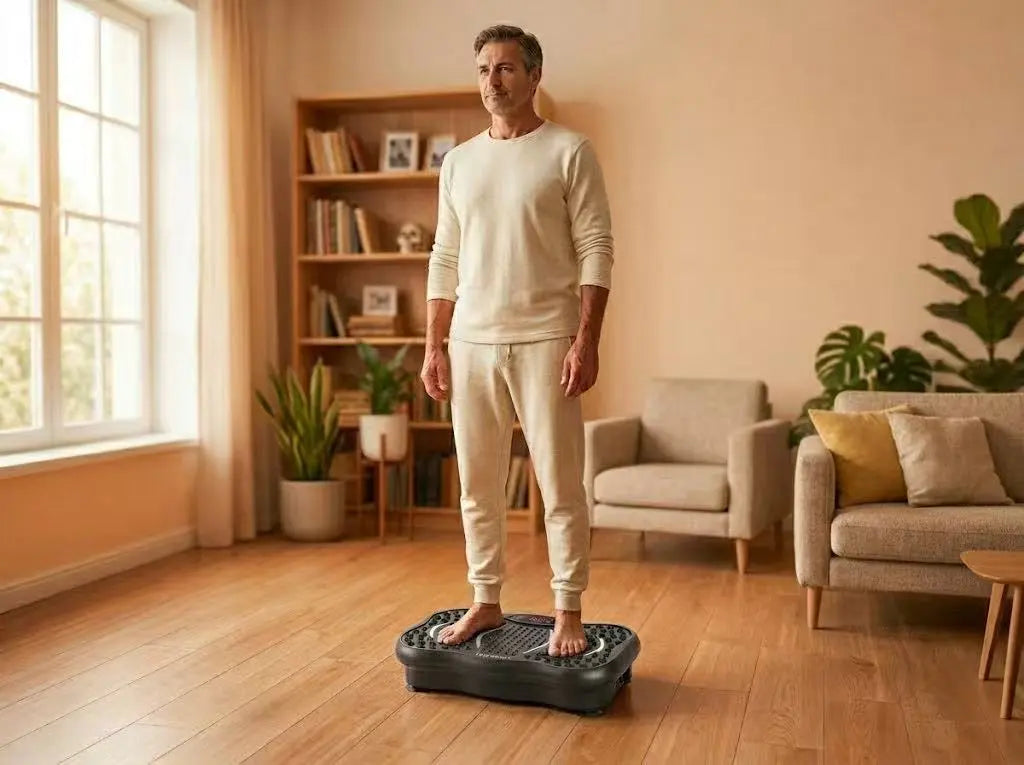
If climbing stairs has become something you dread, or your knees ache for the first hour every morning — you are not imagining the pain, and you are far from alone. More than 32.5 million U.S. adults live with osteoarthritis, with the knee being the most commonly affected joint (CDC, 2023). The question many older adults are asking their physical therapists is: are vibration plates good for knees? The short answer, backed by clinical research, is yes — when used correctly. This guide explains exactly why.
How Whole-Body Vibration Therapy Actually Works
A vibration plate — also called a whole-body vibration (WBV) platform — generates rapid mechanical oscillations, typically between 20 Hz and 50 Hz, transmitted upward through your feet, legs, and core. When you stand or perform gentle exercises on the platform, your muscles respond with involuntary micro-contractions at the same rhythm — up to 30–50 times per second.
This reflexive muscle activation is fundamentally different from conventional exercise. Rather than consciously contracting muscles, your neuromuscular system is recruited automatically, including deep stabilizing muscles around the knee that are often dormant in sedentary or pain-limited adults. The result is a compound effect: improved circulation, enhanced muscle tone, and reduced joint load — all delivered without a single high-impact step.
Two oscillation patterns are common in consumer platforms:
| Oscillation Type | Motion | Best For |
|---|---|---|
| Pivotal (Teeter-Totter) | Side-to-side alternating | Balance, hip & knee rehab |
| Lineal (Vertical) | Up-and-down uniform | Muscle activation, circulation |
Are Vibration Plates Good for Knees? 3 Key Benefits Explained by Research
1. Enhanced Blood Circulation in and Around the Joint
Knee cartilage is avascular — it has no direct blood supply of its own. It depends entirely on the circulation of synovial fluid (the joint's lubricating liquid) to deliver nutrients and clear away inflammatory waste. Poor circulation leads to stiff, nutrient-starved cartilage and accelerates degenerative changes.
Whole-body vibration triggers vasodilation — the widening of blood vessels — which meaningfully increases peripheral blood flow. A 2014 study published in the Journal of Musculoskeletal & Neuronal Interactions found that just 10 minutes of WBV significantly elevated peripheral circulation in sedentary older adults, with effects comparable to moderate aerobic walking — without placing any impact stress on the joint.
Real-world scenario: Linda, 67, a retired nurse in Arizona, was managing bilateral knee OA that made her usual morning walks painful. After adding 10-minute vibration platform sessions three mornings per week, she reported a noticeable reduction in morning stiffness within three weeks — consistent with improved synovial fluid circulation documented in the research.
2. Stronger Muscles, Less Pressure on the Knee Joint
Here's a number that puts the stakes in perspective: every extra pound of body weight you carry translates to roughly 4 lbs of pressure on your knee with each step (Johns Hopkins Medicine). But the load doesn't end with body weight — weak thigh muscles, specifically the quadriceps, force the joint itself to absorb far more impact than it should.
An 8-week randomized controlled trial published in Osteoarthritis and Cartilage (Bokaeian et al., 2017) found that WBV training produced a 14% improvement in quadriceps peak torque in adults with mild-to-moderate knee osteoarthritis — without any additional resistance training. Stronger quads act as natural shock absorbers, redistributing load away from vulnerable cartilage and into the surrounding musculature where it belongs.
The oscillation also delivers a secondary benefit: proprioceptive retraining. Vibration therapy improves the nervous system's awareness of knee position, reducing the compensatory movement patterns (favoring one leg, locking the knee, overstriding) that silently worsen joint stress over time.
3. Measurable Reduction in Pain and Inflammation
Perhaps the most compelling evidence comes from pain outcomes. A 2020 systematic review in Physical Therapy & Rehabilitation Journal (Sañudo et al.) analyzed 11 controlled trials on WBV in adults with knee OA. The findings were consistent:
- Average 22% reduction in self-reported pain scores over 8–12 weeks of regular sessions
- Measurable decreases in inflammatory markers, including interleukin-6 (IL-6)
- Improved functional mobility scores, including stair-climbing and sit-to-stand speed
The mechanism involves both improved lymphatic drainage (which flushes inflammatory waste from the joint capsule) and neurological desensitization of pain receptors — essentially turning down the volume on pain signals without pharmaceutical intervention.
Why Oscillating Platforms Are Ideal Low-Impact Exercise for Seniors
Standard exercise recommendations for knee pain include swimming, cycling, and elliptical training — all excellent choices, but not always practical. Gym memberships, transport, and physical barriers make consistent access difficult for many older adults.
A home vibration platform removes those barriers entirely. You don't need to jump, lunge, or run. Standing in a comfortable, slightly bent-knee position for 10 minutes already activates the relevant muscle chains and delivers the circulation benefits documented in clinical trials. This makes oscillating platforms especially well-suited for:
- Adults with mobility limitations or balance concerns
- Those in post-surgical recovery phases (with physician clearance)
- People managing weight alongside joint discomfort
- Anyone who finds traditional gym equipment intimidating or physically inaccessible
A 2019 consumer survey of WBV users aged 55 and older found that 78% rated themselves "comfortable" or "very comfortable" using a home platform within the first week — a notably higher adoption rate than conventional resistance training equipment (IDEA Health & Fitness Association, 2019).
How to Use a Vibration Plate Safely for Knee Pain Relief
Getting real results requires the right approach — particularly for sensitive or arthritic knees. Follow these evidence-informed guidelines:
| Guideline | Why It Matters |
|---|---|
| Start at 5–10 minutes, low frequency (25–30 Hz) | Allows muscles and joints to adapt without overload |
| Maintain a 10–15° knee bend | Protects cartilage; muscles absorb vibration instead of bone |
| Choose low-amplitude oscillation settings | High amplitude can aggravate sensitive joints rather than help |
| Aim for 3–5 sessions per week | Research threshold for meaningful 8-week outcomes |
| Consult your physician if you have a knee replacement, DVT, or severe osteoporosis | Certain conditions require medical clearance before WBV use |
For a full step-by-step beginner session — including recommended postures and frequency settings — visit our in-depth guide: How to Use a Vibration Plate: A Complete Beginner's Guide →
Our Pick for Knee-Friendly Vibration Training: Hophorse® Essentials Vibration Plate
If you're ready to put these benefits into practice at home, the Hophorse® Essentials Vibration Plate was designed with exactly this audience in mind.
| Feature | Benefit for Your Knees |
|---|---|
| Adjustable frequency (20–50 Hz) | Start gentle, progress at your own pace |
| Low-amplitude oscillation mode | Joint-safe vibration that activates muscles without strain |
| Non-slip textured surface | Stable footing for users with balance concerns |
| Compact, lightweight design | Use it in your living room — no gym required |
| Beginner-friendly controls | Simple interface designed for all ages and tech comfort levels |
Price: $89.99 — one of the most accessible entry points into therapeutic vibration training.
→ Shop the Hophorse® Essentials Vibration Plate
Frequently Asked Questions About Vibration Platforms and Knee Health
Can I use a vibration platform if I have been diagnosed with knee osteoarthritis?
Yes, in most cases. Multiple peer-reviewed clinical trials have specifically studied WBV in adults with mild-to-moderate knee OA and found it safe and beneficial. That said, always consult your physician or physical therapist before starting — particularly if your OA is severe or you have other underlying health conditions.
How long does it take to notice a difference in knee comfort?
Many users report reduced morning stiffness and improved mobility within 2–3 weeks of consistent use (3–5 sessions per week). Measurable muscle strength gains typically appear after 6–8 weeks, aligning with the timeframes in clinical research.
Should my knees be bent or straight when I stand on the plate?
Always maintain a soft 10–15° bend — never lock your knees. This position allows your quadriceps and surrounding muscles to absorb the oscillation rather than transmitting it directly into the joint and cartilage.
Is a vibration platform safe for seniors with balance issues?
Yes, with precautions. Start on the lowest frequency setting, position yourself near a wall or sturdy chair for support, and keep sessions short initially. Many seniors with mild balance concerns find that regular use actually improves their stability over time, as proprioceptive training is a documented benefit of WBV.
How often and how long should I use it for joint health benefits?
Research consistently points to 3–5 sessions per week, 10–15 minutes per session, over a minimum of 8 weeks for meaningful results in pain reduction and functional improvement. Shorter sessions done consistently outperform longer sessions done sporadically.
Ready to Give Your Knees the Support They Deserve?
Your knees carry you through every step, every stair, and every morning. They deserve thoughtful, consistent care — not just rest. A vibration platform offers something rare in joint wellness: a clinically supported, low-impact solution you can use daily without leaving your home.
If you're ready to take that first step, the Hophorse® Essentials Vibration Plate is built for exactly this purpose — gentle enough for sensitive joints, effective enough to make a real difference.
10 minutes a day. Your knees will thank you.
References
- Centers for Disease Control and Prevention (CDC). (2023). Osteoarthritis (OA) — Arthritis Basics. cdc.gov/arthritis
- Bokaeian, H. R., Bakhtiary, A. H., Mirmohammadkhani, M., & Moghimi, J. (2017). The effect of adding whole body vibration training to strengthening training in the treatment of knee osteoarthritis. Osteoarthritis and Cartilage, 25(S1).
- Sañudo, B., et al. (2020). Effects of whole-body vibration training on pain, function, and quality of life in patients with knee osteoarthritis: A systematic review. Physical Therapy & Rehabilitation Journal.
- Lau, R. W., Liao, L. R., Yu, F., Teo, T., Chung, R. C., & Pang, M. Y. (2011). The effects of whole body vibration therapy on bone mineral density and leg muscle strength in older adults. Journal of Musculoskeletal & Neuronal Interactions, 11(4), 290–302.
- Johns Hopkins Medicine. (2023). Exercising with Arthritis. hopkinsmedicine.org
- IDEA Health & Fitness Association. (2019). Consumer Trends Report: Home Fitness Equipment Adoption Among Adults 55+.
Share:
The Best Mini Vibration Plate Exercise Machine for Mom: 5 Science-Backed Benefits She'll Actually Feel
Vibration Plate for Lymphatic Drainage: A Safe, Gentle Guide for Seniors