
Your body just did something extraordinary — and yet the mirror shows a soft, unfamiliar belly that no amount of walking or cutting calories seems to touch. You're exhausted, your core feels disconnected, and traditional workouts feel completely out of reach. You're not doing anything wrong. Postpartum belly fat is biologically different from regular fat, and it needs a different solution.
If you've been wondering whether a power plate for belly fat could be the low-impact answer you've been searching for, this guide is written for you. We'll cover the science, a safe starter routine, and everything you need to know to begin rebuilding your core — gently, from home, in as little as 10 minutes a day.
Why Postpartum Belly Fat Behaves Differently from Regular Body Fat
After pregnancy, the body undergoes a cascade of hormonal and structural changes that make abdominal fat notoriously stubborn. Understanding why is the first step toward solving it.
During the nine months of pregnancy, the rectus abdominis muscles separate along the midline — a condition called diastasis recti. Research published in the Journal of Orthopaedic & Sports Physical Therapy (Lee & Hodges, 2016) found that up to 60% of women experience diastasis recti postpartum, causing the characteristic belly "pooch" that persists even as weight drops elsewhere.
Alongside this structural change, elevated cortisol from sleep deprivation actively directs fat storage toward the abdomen. Oestrogen and relaxin fluctuations further reduce connective tissue tone, while a weakened pelvic floor makes high-impact core work counterproductive — and sometimes harmful.
Is a Power Plate for Belly Fat Safe and Effective After Pregnancy?
Yes — when introduced at the right time and used correctly. Whole-body vibration platforms (the clinical name for power plates) produce rapid, low-amplitude oscillations that trigger involuntary muscle contractions throughout the body. At low intensity settings, these contractions are gentle enough to re-engage the deep stabilising muscles — the transverse abdominis and multifidus — without compressing the spine or loading the pelvic floor.
What the research shows
- Core muscle activation: A 2014 review in the European Journal of Applied Physiology confirmed that whole-body vibration activates deep trunk stabilisers at rates comparable to conventional core exercises — with significantly lower perceived exertion.
- Metabolic uplift: Even a 10–15 minute session has been shown to elevate heart rate and increase caloric expenditure above resting baseline. Combined with increased muscle recruitment, this creates a real — if modest — metabolic effect without any jumping or running.
- Lymphatic drainage: The oscillatory motion promotes lymphatic flow, helping to reduce postpartum water retention and the bloating that makes many women feel "bigger than they are" in the early months.
- Cortisol reduction: Several small clinical trials have linked low-intensity vibration training to reduced cortisol levels — directly addressing one of the core hormonal drivers of abdominal fat storage after pregnancy.
When to Start: A Safe Postpartum Timeline for Vibration Training
Before beginning any exercise programme after giving birth, get individual clearance from your OB-GYN or midwife. The table below is a general evidence-informed guide only.
| Postpartum Stage | What Your Body Needs | Vibration Platform Use |
|---|---|---|
| Weeks 1–6 | Rest, wound healing, hormonal stabilisation | Not recommended — await medical clearance |
| Weeks 6–12 | Gentle movement, pelvic floor reconnection | Low intensity (speed 1–3), standing only, max 5–8 min |
| 3–6 Months | Core re-activation, building endurance | 10–12 min sessions; add gentle squats and balance work |
| 6+ Months | Progressive strength, targeted fat reduction | Full 15-min routines; varied positions and moderate intensity |
C-section, surgical repair, or diagnosed diastasis recti? Always follow your doctor's specific guidance — the above is for general reference only.
A Gentle Vibration Workout Routine to Rebuild Core Strength After Pregnancy
This routine is designed for women at the 3-month+ postpartum stage who have received medical clearance. Aim for 3–4 sessions per week, preceded by a 5-minute gentle walk to warm up.
| Exercise | Duration | Speed Setting | Primary Benefit |
|---|---|---|---|
| Standing (feet shoulder-width, knees soft) | 2 min | Low (1–3) | Deep core activation, proprioception |
| Shallow squat holds (5 sec each) | 2 min | Low–Medium (3–5) | Glute & quad engagement, posture reset |
| Single-leg balance (10 sec each side) | 2 min | Low (2–4) | Pelvic stabilisation, deep core |
| Gentle hip hinge (soft deadlift position) | 2 min | Medium (5–7) | Posterior chain, lower back strength |
| Standing cool-down (breathe slowly) | 2 min | Low (1–2) | Lymphatic drainage, muscle recovery |
Technique tip: Before each movement, take a slow belly breath in, then gently draw your lower abdomen in as you exhale — this pre-activates the transverse abdominis and dramatically increases the core benefit of every exercise.
If you feel any pelvic pressure or discomfort, reduce the speed immediately and stop the session. Progress should always feel gradual and completely manageable.
Ready for a deeper tutorial? Visit our full beginner's guide: How to Use a Vibration Plate: A Complete Beginner-Friendly Guide →
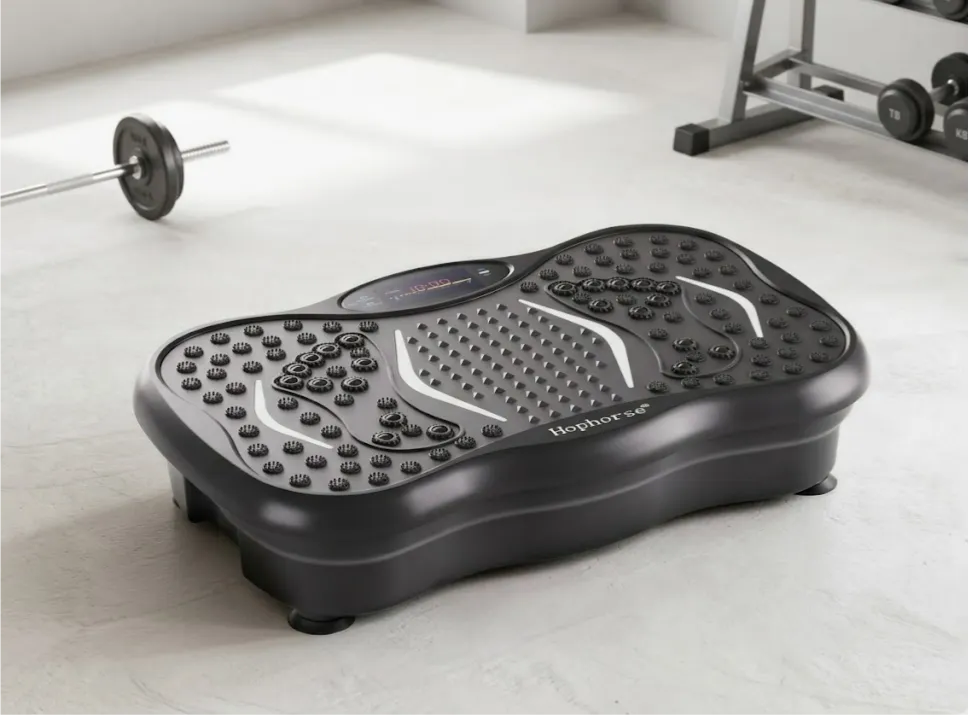
Hophorse® Essentials Vibration Plate
The Hophorse® Essentials Vibration Plate is designed for exactly this kind of gentle, progressive home recovery. It's compact enough to slide under a sofa, quiet enough to use during nap time, and straightforward enough that you don't need any fitness background to get started.
- ✔ Multiple speed levels — start low, progress at your own pace
- ✔ Compact & lightweight — no dedicated gym space required
- ✔ Low-noise motor — won't wake a sleeping baby
- ✔ 30-day return policy & free US shipping
- ✔ Ships within 1–2 business days from a US warehouse
5 Expert Tips to Get Better Results and Reduce Belly Fat Faster
- Lead with diaphragmatic breathing. Start every session with 3–5 slow belly breaths before stepping on the platform. This primes the deep core and increases the toning effect of each vibration cycle.
- Consistency beats intensity. Three 10-minute sessions per week will outperform one 45-minute marathon every time. The postpartum body responds best to frequent, gentle stimulus — not occasional high effort.
- Use it in the morning. Morning sessions help regulate cortisol levels for the rest of the day — reducing the primary hormonal driver of stubborn abdominal fat storage in postpartum women.
- Prioritise protein intake. Research consistently shows postpartum fat loss accelerates when daily protein intake reaches 1.4–1.7 g per kg of body weight. This also supports muscle recovery and, if you're breastfeeding, milk quality.
- Track inches, not just the scale. Vibration training often reduces waist circumference and improves tone while the number on the scale stays flat (due to simultaneous muscle development). Measure your waist every two weeks for a truer picture of progress.
Frequently Asked Questions
Most healthcare providers recommend waiting a minimum of 6 weeks postpartum before any structured exercise, including vibration training. After a C-section or significant pelvic floor injury, the recommended wait is often longer. Always get individual clearance from your doctor or midwife before starting.
Yes — gentle vibration training is generally considered safe while breastfeeding, provided you stay well hydrated and keep the intensity low. There is no clinical evidence that low-intensity sessions affect milk supply or milk quality. If you have any concerns, check with your lactation consultant first.
A vibration platform is not a standalone treatment for diastasis recti, but it can be a useful tool within a broader recovery plan. The deep core activation it promotes — particularly the transverse abdominis — supports the healing process when combined with DR-safe exercises. If you have a confirmed separation, work alongside a pelvic floor physiotherapist who can guide your programme.
Most women notice reduced bloating and improved posture within 2–3 weeks of consistent use. Measurable changes in abdominal firmness and waist circumference typically appear within 4–8 weeks, depending on nutrition, sleep, and starting fitness level. Postpartum recovery is a marathon — progress that feels slow is still real progress.
Absolutely. The Hophorse® Essentials Vibration Plate is designed for home users starting from zero. You can begin at the lowest speed setting — simply standing still for 5 minutes — and build from there at whatever pace your body allows. No fitness experience is needed.
Ready to Start Your Postpartum Recovery?
Join thousands of moms who are gently rebuilding their core strength, reducing abdominal softness, and feeling at home in their bodies again — 10 minutes at a time, from the comfort of home.
Shop the Hophorse® Essentials Plate — $89.99Free US shipping · 30-day returns · Ships within 1–2 business days
1. Lee D, Hodges PW. "Behavior of the Linea Alba During a Curl-up Task in Diastasis Rectus Abdominis." Journal of Orthopaedic & Sports Physical Therapy. 2016;46(7):580–589.
2. Ritzmann R, Kramer A, Gruber M, et al. "EMG activity during whole body vibration: motion artifacts or real activity?" European Journal of Applied Physiology. 2010;110(1):143–151.
3. Marín PJ, Rhea MR. "Effects of Vibration Training on Muscle Strength: A Meta-Analysis." Journal of Strength and Conditioning Research. 2010;24(2):548–556.
4. Bogaerts ACG, Delecluse C, Claessens AL, et al. "Effects of whole body vibration training on cardiorespiratory fitness and muscle strength in older individuals." Age and Ageing. 2009;38(4):448–454.
5. American College of Obstetricians and Gynecologists (ACOG). "Physical Activity and Exercise During Pregnancy and the Postpartum Period." Committee Opinion No. 804, 2020.
Share:
Is a Portable Vibration Plate Good for Seniors?
The Truth About Using a Vibration Plate for Weight Loss at Your Desk