
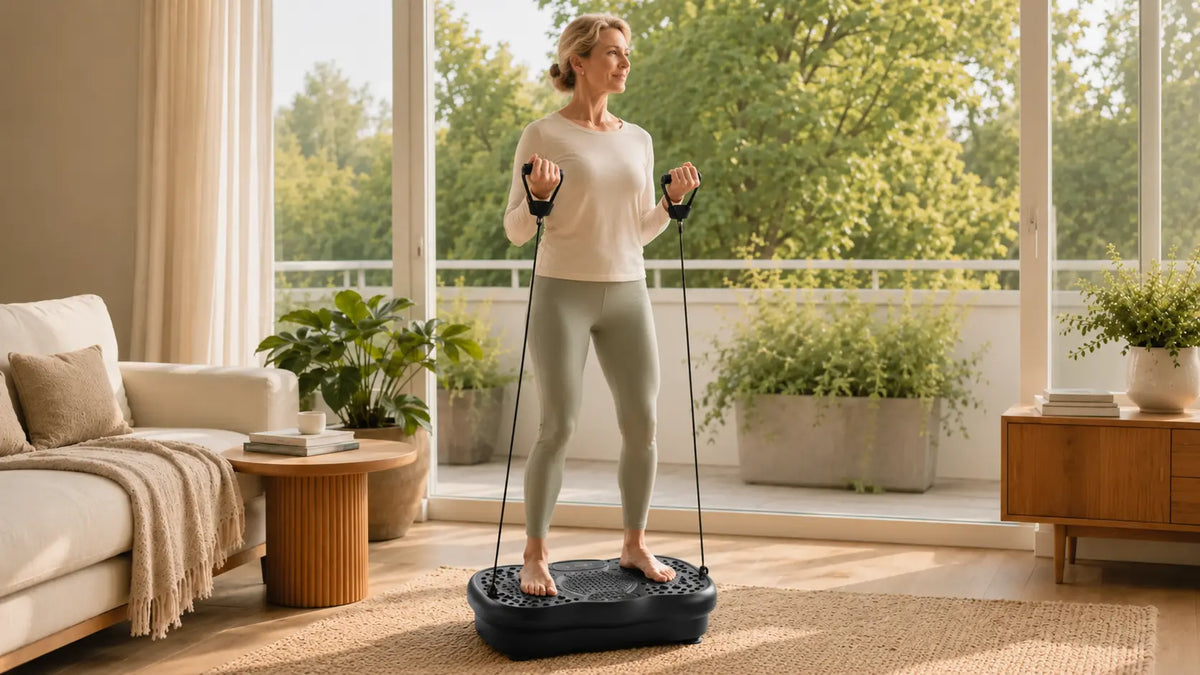
A vibration plate with resistance bands can be worth it when you want one compact tool for both lower-body vibration and simple upper-body movement. The plate provides an unstable, moving surface that asks your legs and core to stay engaged, while the bands let you add controlled rows, curls, presses, and other light exercises. That combination can make a short home session feel more complete without requiring a rack of weights. However, the bands do not automatically make every workout better. Their value depends on secure attachment points, suitable resistance, stable posture, and exercises you can perform with control. For beginners, busy adults, and people building a low-impact home routine, included bands are useful—provided they are treated as an accessory rather than a shortcut to guaranteed results.
- Resistance bands add upper-body options to a vibration plate routine.
- The best setup is stable, easy to control, and comfortable at low speeds.
- Beginners should learn their stance before combining vibration with band exercises.
- A 5–10 minute session can be practical, but good form matters more than speed.
- The combination is most useful for consistency and variety—not dramatic promises.

What Do Resistance Bands Add to a Vibration Plate?
A vibration plate on its own is mainly a platform for standing positions, shallow squats, calf raises, supported lunges, planks, and recovery-style movement. Your lower body and trunk work to maintain position as the platform moves. When resistance bands are connected to the base, you can also train pulling and pressing patterns without adding separate dumbbells.
Practical options include controlled curls, low rows, lateral raises, and light presses. Because the platform is moving, use less band tension than you might use on the floor.
| Feature | Plate Only | Plate With Bands |
|---|---|---|
| Main emphasis | Lower body, stance, balance, and core engagement | Lower body plus light upper-body pulling and pressing |
| Exercise variety | Standing, squat, calf raise, plank, stretch | Adds curls, rows, raises, and controlled presses |
| Space required | Compact floor area | Compact floor area plus clear arm space |
| Learning curve | Lower | Slightly higher because posture and band tension must be managed together |
Who Is a Vibration Plate With Resistance Bands Best For?
This combination makes the most sense for people who value convenience more than heavy resistance, especially when exercise needs to fit before work, after long sitting hours, or into a busy evening.
- Beginners: The controls and band movements can be scaled down while you learn.
- Busy adults: One compact setup reduces the need to gather several pieces of equipment.
- Apartment or small-home users: A compact plate can fit into a living room, bedroom, or home workout corner.
- Adults returning to movement: Short sessions can feel less intimidating than a long gym workout.
- People who want more variety: Bands provide options beyond simply standing on the platform.
It is less suitable for progressive strength training with heavier loads. Included bands are an accessible home accessory, not a full replacement for a structured resistance program.

Benefits and Limitations to Consider
Potential advantages
The strongest reason to choose this setup is variety. You can move from a basic stance to a light row or curl without changing equipment, which can make a short routine easier to repeat. The bands also ask you to keep your knees soft, trunk steady, and shoulders controlled.
Important limitations
The bands may not provide enough resistance for experienced strength trainees, and not every exercise belongs on a moving platform. Avoid fast repetitions, deep squats, aggressive overhead movements, and anything that exceeds your balance ability. Connect bands only to the designated attachment points, and stop using them if you notice cracks, thinning, damaged clips, or loose hardware.
A Beginner-Friendly 10-Minute Routine
This routine keeps the movements simple and uses low to moderate resistance. Begin at a low vibration setting. Keep your knees slightly bent, your feet fully supported, and your movements slow enough to stop at any time.
- Comfortable standing — 2 minutes: Stand with feet about hip-width apart. Hold the handles loosely without pulling and get used to the platform movement.
- Alternating biceps curls — 2 minutes: Keep elbows close to your sides. Curl one or both handles through a comfortable range without leaning back.
- Low rows — 2 minutes: Hinge only slightly at the hips, keep your chest lifted, and draw the handles toward your ribs.
- Shallow knee bends with light band tension — 2 minutes: Keep the movement small. The bands are for stability and gentle tension, not for pulling yourself upright.
- Easy standing finish — 2 minutes: Release band tension, lower the speed, breathe normally, and step off only after the plate stops.

For a more detailed setup sequence, read how to use a vibration plate for beginners. It explains basic stance, speed selection, and short-session planning before you add more movement.
Compare compact models, included accessories, speed controls, and platform designs in the current collection.
Compare Hophorse Vibration PlatesHow to Choose a Vibration Plate With Resistance Bands
Do not choose by speed count alone. A useful home model should feel stable, adjust gradually, and have controls you can reach without losing your stance. Review these points:
- Secure band attachment: Look for clearly designed connection points and clips that are easy to inspect.
- Stable platform: A non-slip standing area and steady base help you maintain control.
- Beginner-friendly adjustment: Low settings and simple controls are more useful than maximum intensity.
- Suitable platform size: You should have enough room for a comfortable stance without placing your feet near the edge.
- Home-friendly operation: Consider sound, storage space, cord placement, and where you will use it.
- Clear support policies: Check shipping, returns, warranty terms, and access to product guidance.

For most beginners, the Hophorse Whole Body Vibration Plate is a practical starting point because it combines adjustable controls, a compact home format, and included bands. The Hophorse SYC Vibration Plate is another option for users comparing different platform designs and control ranges.
If you want a wider platform and more room to progress, the Hophorse Pro Max Vibration Plate may be a better fit. Users who prefer a compact model with extensive speed control can also review the Hophorse Pro Vibration Plate. You can compare all Hophorse vibration plates before deciding.
| Model | Practical fit | What to review |
|---|---|---|
| Whole Body Vibration Plate | Beginners and everyday home routines | Included bands, compact setup, control options |
| SYC Vibration Plate | Users comparing an alternative platform format | Platform feel, available modes, current specifications |
| Pro Max Vibration Plate | Users wanting a wider, higher-support platform | Available floor space, platform dimensions, current accessories |
| Pro Vibration Plate | Compact routines with broad speed adjustment | Band compatibility and current included accessories |
Safety and Setup Considerations
Use a hard, level surface with clear space around your arms and feet. Confirm that both clips are closed, keep the cord away from your stance, and avoid locking your knees.
Stop the session if you feel dizzy, unsteady, numb, unusually short of breath, or otherwise unwell. A vibration plate is a fitness tool, not a medical treatment. Use it within your ability and follow the instructions supplied with your specific model.

So, Is It Worth It?
For many home fitness users, yes. It is worth considering when your priorities are a compact setup, short routines, gentle movement, and more exercise variety than a platform alone provides.
The value is lower if you expect heavy strength training, advanced balance work, or guaranteed body-composition changes. Choose the combination because it makes movement easier to fit into your day—not because it promises an instant result. A model you can use comfortably and consistently is usually more useful than one with the longest feature list.

Frequently Asked Questions
Is a vibration plate with resistance bands good for beginners?
Yes, it can be beginner-friendly when you start at a low speed, learn a stable stance first, and use light band tension. Add one simple exercise at a time rather than combining several movements immediately.
Do resistance bands make a vibration plate workout more effective?
They can make the session more complete by adding upper-body resistance and exercise variety. They do not guarantee better results; controlled form, suitable tension, and consistent use remain more important.
How long should I use resistance bands on a vibration plate?
Beginners can start with one or two band exercises within a 5–10 minute session. Use short intervals, rest as needed, and follow the time and intensity guidance in the manual for your specific machine.
Can seniors use a vibration plate with resistance bands?
Some older adults may prefer low-impact home movement, but balance, bone health, medications, and existing conditions matter. Seniors should consult a healthcare professional before use when there are health or stability concerns.
Should I wear shoes when using the resistance bands?
Supportive, flat athletic shoes can provide traction and may help beginners feel more stable. Follow the manufacturer’s instructions and avoid footwear that slips or prevents secure contact with the platform.
Can I attach any resistance bands to a vibration plate?
No. Use bands and clips that are compatible with the machine’s designated attachment points. Do not improvise connections, and replace bands that show cracks, thinning, damaged clips, or other wear.
Review current models and choose the platform size, controls, and accessories that fit your routine and space.
Shop Hophorse Vibration Plates
Share:
Best Vibration Plate Under $90
Who Should Not Use a Vibration Plate?