
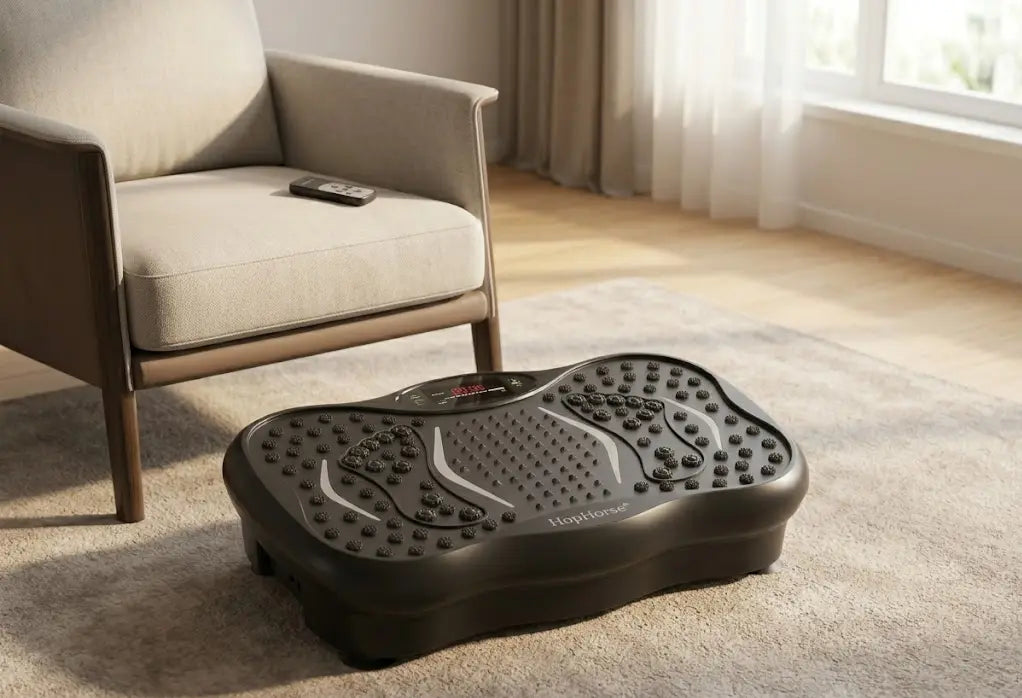
Do your knees ache after a short walk? Does standing on one foot feel shakier than it used to? You're not alone — and you don't have to accept these changes as simply "getting older." A portable vibration plate is emerging as one of the most talked-about low-impact tools for adults over 50 who want to stay active, improve balance, and support circulation — all from the comfort of home, and without pounding joints on a treadmill.
In this guide, we break down exactly how whole-body vibration works, what the research says for older adults, and how to get started safely — even if you haven't exercised in years.
What Is a Portable Vibration Plate and How Does It Work?
A vibration plate is a compact platform that generates rapid oscillations — typically 15 to 60 Hz — beneath your feet. When you stand, sit on a chair in front of it, or rest your hands on it, the gentle tremors force hundreds of tiny, involuntary muscle contractions per second throughout your legs, core, and lower back.
Unlike a treadmill or exercise bike, a vibration platform asks almost nothing of your cardiovascular system. You simply stand on it. Yet those micro-contractions recruit muscle fibres, nudge the lymphatic system, and stimulate blood flow — all simultaneously. That's the core reason physical therapists and sports medicine specialists have begun recommending whole-body vibration (WBV) as a complement to conventional rehabilitation programmes.
Why "portable" matters for older adults: A home-friendly unit like the Hophorse® Essentials Vibration Plate weighs under 20 lbs, slides under a sofa when not in use, and runs quietly enough to use while watching television. No gym membership. No commute. No risk of tripping on uneven pavement.
4 Proven Benefits of Vibration Therapy for Older Adults
1. Better Blood Circulation — Without High-Intensity Cardio
Poor circulation in the legs is one of the leading complaints among adults over 60, contributing to swollen ankles, cold feet, and fatigue. Standing on a vibrating platform acts like a gentle "second heart": the rhythmic contractions in the calf muscles push venous blood back toward the heart.
A 2014 review published in Clinical Rehabilitation found that just 10 minutes of WBV significantly increased peripheral blood flow in older sedentary participants — an effect comparable to 20 minutes of light walking, yet with far less cardiovascular load. For seniors who find sustained cardio difficult due to breathlessness or joint pain, this is a meaningful alternative.
Real-world use: Many users keep their vibration platform in front of the TV. A 10-minute standing session during the morning news is enough to notice reduced leg heaviness throughout the day.
2. Balance Training That Reduces Fall Risk
Falls are the number-one cause of injury-related death in adults over 65, according to the CDC. Declining proprioception — the body's sense of where it is in space — is a primary contributor. Vibration therapy directly targets this by constantly challenging your postural muscles to maintain stability on a moving surface.
A randomised controlled trial in the Archives of Physical Medicine and Rehabilitation (2011) reported that older adults who completed an 8-week WBV programme showed a 29% improvement in balance scores compared with a control group. Participants also reported greater confidence when walking on uneven ground.
Practical tip: Start with both hands lightly resting on a wall or the back of a sturdy chair. Even a two-minute standing session at low frequency (15–20 Hz) is enough to begin retraining your stabiliser muscles.
3. Joint-Friendly Muscle Activation
Arthritis, osteoarthritis, and post-surgical stiffness make traditional strength training painful or impossible for millions of older adults. Whole-body vibration offers a workaround: muscle activation without heavy loading. The oscillations stimulate the muscle spindles, triggering contractions without the compressive force of squats or lunges with weights.
Research published in the Journal of Musculoskeletal & Neuronal Interactions (2017) found that 12 weeks of low-frequency WBV improved quadriceps strength in knee osteoarthritis patients by approximately 18%, while simultaneously reducing self-reported pain scores by 23% — without a single traditional resistance exercise.
Important note from physical therapists: Always begin at the lowest intensity setting, keep knees slightly bent (never locked), and wear soft-soled shoes. Progress slowly over several weeks before increasing frequency or duration.
4. Lymphatic Drainage and Reduced Swelling
The lymphatic system, unlike the circulatory system, has no pump of its own — it relies entirely on muscle movement and gravity to move fluid through the body. For less active seniors, lymph can pool in the lower legs, causing puffiness and discomfort.
Because a vibration platform triggers continuous small muscle contractions across the legs, hips, and abdomen, it effectively mimics the pumping action that would otherwise require extended walking. Anecdotally, users frequently report noticeably less ankle swelling after consistent daily use of 10–15 minutes.
Is a Portable Vibration Plate Safe for Seniors? What Doctors Say
The short answer is: yes, for most older adults — with appropriate precautions. Dr. Clinton Rubin, a pioneer in WBV research at Stony Brook University, has described low-magnitude, high-frequency vibration as "mechanically benign" and suitable for fragile populations when used correctly.
The NHS and several American geriatric care guidelines note that WBV can be a safe adjunct therapy for fall prevention and muscle maintenance in older populations, particularly when supervised initially.
| Who Can Use With Confidence | Consult Your Doctor First | Avoid Until Medically Cleared |
|---|---|---|
| Generally healthy adults 50+ | History of osteoporosis | Acute deep-vein thrombosis |
| People with mild arthritis | Recent joint replacement (< 6 months) | Active fracture or healing bone |
| Those with poor circulation | Cardiovascular conditions / pacemaker | Severe inner-ear or balance disorders |
| Sedentary individuals restarting activity | Diabetic neuropathy | Acute herniated disc (lumbar) |
Always start with 5–10 minutes at the lowest speed setting, 2–3 times per week. Increase gradually over 4–6 weeks as your body adapts.
Our Recommendation: The Best Home Vibration Platform for Seniors
Not all vibration machines are created equal for an older audience. Seniors need a wide, stable platform, simple controls, a low noise output (to avoid disturbing housemates), and — critically — a remote control so they never have to bend down to adjust settings mid-session.
Staff Pick — Best for Seniors
Hophorse® Essentials Vibration Plate
$89.99
- 200 precision speed levels — start as low as 15 Hz, perfect for beginners
- Wide non-slip platform with textured surface for confident footing
- Whisper-quiet motor (< 40 dB) — quieter than a normal conversation
- Included remote control — no bending down to adjust settings
- Ultra-slim 5.7″ profile slides under any sofa or bed
- Supports up to 460 lbs with a heavy-duty reinforced frame
- 30-day return policy + US-based customer support
The remote control is the feature older users mention most in reviews. Being able to step on the platform, stand comfortably, and then adjust intensity from an upright position removes one of the biggest safety hazards: losing balance while reaching down.
A Simple 10-Minute Starter Routine for Seniors
You do not need any prior fitness experience. For a full breakdown of every move, check out our complete guide to using a vibration plate. The routine below is specifically designed for adults who haven't exercised regularly, or who are managing joint discomfort.
| Minute | Position | Speed Setting | Goal |
|---|---|---|---|
| 0–2 | Stand with feet hip-width, slight knee bend, hands on wall/chair | Level 1–5 (lowest) | Warm-up, body adjustment |
| 2–5 | Same stance, arms relaxed at sides (or hold resistance bands) | Level 5–15 | Circulation & leg activation |
| 5–8 | Seated on chair, feet flat on platform | Level 10–20 | Ankle & calf drainage |
| 8–10 | Stand again, gentle calf raises (heel up, heel down) | Level 5–10 | Cool-down & balance |
Aim for this routine 3 times per week for the first month. After 4 weeks, you can gradually extend sessions to 15 minutes and experiment with slightly higher speeds. Already comfortable with the basics? Read our complete beginner's guide to vibration plate exercises →
Frequently Asked Questions
Can I use a vibration platform if I have knee or hip arthritis?
Many people with mild to moderate arthritis find low-frequency vibration actually eases stiffness rather than aggravating it, because there's no impact loading on the joint. However, we strongly recommend consulting your rheumatologist or physiotherapist before starting, particularly if you have moderate to severe arthritis or have had joint replacement surgery within the past 12 months.
How long before I notice results?
Most seniors report noticeable improvements in leg heaviness and circulation within 1–2 weeks of consistent use. Balance and muscle tone improvements typically become apparent after 4–8 weeks, based on clinical trial timelines. Consistency matters more than intensity at this stage.
Is it safe to use every day?
Short sessions of 10 minutes at low intensity can be used daily for most healthy older adults. Hophorse recommends starting with 3 sessions per week to allow your neuromuscular system to adapt, then progressing to daily use if you feel comfortable. Stop immediately if you experience dizziness, unusual joint pain, or nausea.
Do I need to stand on it, or can I sit?
Both work well for seniors. Standing delivers greater whole-body benefits, but sitting on a chair with your feet flat on the platform is a valid option if standing for extended periods is uncomfortable. The seated position still stimulates circulation in the lower legs and ankles effectively.
What's the difference between a vibration plate and a balance board?
A balance board challenges your proprioception through unstable tilting — requiring active correction. A vibration platform is passive: it provides stimulation while you remain relatively still, making it significantly safer and less demanding for seniors with limited mobility or confidence on their feet.
Ready to Move More — Gently and Safely?
You don't have to push through pain or risk a fall to stay active. The Hophorse® Essentials Vibration Plate was designed for everyday use by everyday people — including those of us who need fitness to work with our bodies, not against them. Join thousands of users who have made 10-minute morning sessions part of their wellness routine.
Get the Hophorse® Essentials — $89.99 →Free US shipping · 30-day returns · US-based support
References
- Lau RW, et al. "The effects of whole body vibration therapy on bone mineral density and leg muscle strength in older adults: a systematic review and meta-analysis." Clinical Rehabilitation, 2011;25(11):975–988.
- Gusi N, et al. "Low-frequency vibratory exercise reduces the risk of bone fracture more than walking: a randomised controlled trial." BMC Musculoskeletal Disorders, 2006;7:92.
- Rogan S, et al. "Whole-body vibration for osteoporosis: state of the literature." Journal of Musculoskeletal & Neuronal Interactions, 2017;17(3):167–175.
- Sitjà-Rabert M, et al. "Efficacy of whole body vibration exercise in older people: a systematic review." Disability and Rehabilitation, 2012;34(11):883–893.
- Centers for Disease Control and Prevention. "Falls Prevention Facts." Accessed 2024. cdc.gov/falls
- Rubin C, et al. "Prevention of postmenopausal bone loss by a low-magnitude, high-frequency mechanical stimuli." Drug Discovery Today, 2002;7(7):395–396.
Share:
Is Vibration Good for Knee Pain? Recovery Guide for Athletes