
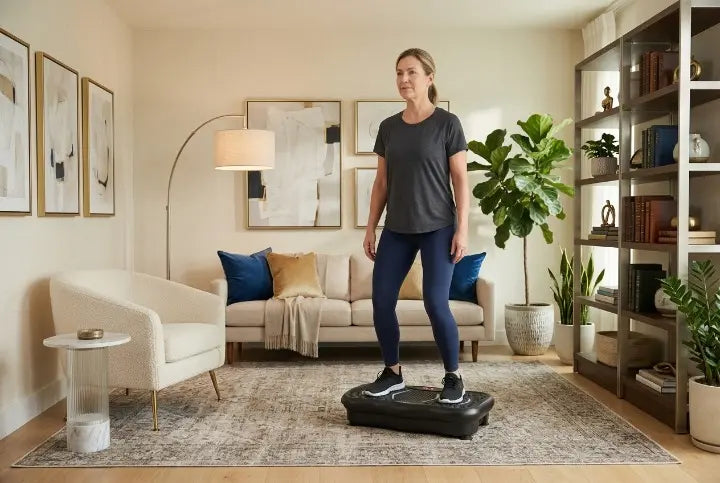
Walking and vibration plate exercise can both support a more active routine, but they are not the same type of movement. Walking moves your body through space and is primarily an aerobic activity. A vibration plate keeps you on a compact platform while its movement challenges your muscles to stabilize your body. That makes the vibration plate vs walking comparison less about choosing a winner and more about understanding what each one is good at. Walking remains an accessible way to accumulate daily movement and cardiovascular activity, while a vibration plate can provide a convenient, low-impact option for short home sessions, muscle activation, and simple strength-focused movements. For many people, the most practical routine can include both.

Vibration Plate vs Walking: Quick Comparison
The biggest difference is simple: walking is locomotion, while vibration training is stationary exercise performed on a moving platform. You should therefore avoid treating minutes on a vibration plate as a direct conversion into walking steps or miles.
| Feature | Vibration Plate | Walking |
|---|---|---|
| Primary movement | Stationary vibration with standing or controlled exercises | Repeated forward steps |
| Typical focus | Muscle activation, stability and home exercise | Daily movement and aerobic activity |
| Impact | Low-impact when used appropriately | Generally low-impact |
| Space required | Small indoor footprint | Outdoor route, treadmill or indoor walking space |
| Weather dependent | No | Outdoor walking can be |
| Can include strength movements? | Yes, such as shallow squats and resistance-band exercises | Usually requires added exercises or resistance |
| Counts as actual steps? | No | Yes |
| Useful for short home sessions? | Yes | Yes, if you have suitable space or a treadmill |
How Do Vibration Plates and Walking Work Differently?
What happens when you walk
Walking requires you to repeatedly shift your body weight, take steps and move through space. Your legs and hips work with each stride, while your cardiovascular system responds to the pace, duration, terrain and incline.
That makes walking particularly useful for accumulating everyday physical activity. It can be as simple as walking around your neighborhood, taking a longer route through the store or using a walking pad while working.
What happens on a vibration plate
A vibration plate uses rapid platform movement while you stand or perform controlled exercises on it. Your muscles respond as they work to maintain posture and stability. Depending on the exercise, you can use the platform for a basic stance, shallow squat, calf raise or resistance-band movement.
This creates a different type of training stimulus from walking. Rather than covering distance, the emphasis is on maintaining control and engaging muscles while the platform moves beneath you.

Which Is Better: A Vibration Plate or Walking?
Neither option is universally better. The more useful question is which activity fits what you want to do today.
Choose walking when you want aerobic movement
If your priority is getting outside, covering distance or adding more traditional aerobic activity to your day, walking is the more direct choice. It is also simple to track through time, distance or steps.
Consider a vibration plate when convenience is the barrier
A vibration plate can make sense when you want to move at home but do not have time for a longer outing. A compact platform can stay within easy reach in a bedroom, living room or home workout corner, making a short routine easier to fit before work, after long sitting hours or while watching TV.
This can be especially appealing for beginners and busy adults who value a routine that does not require much setup. Adjustable settings also let you begin conservatively and progress according to your comfort.

What about muscle activation?
Both activities use muscles, but in different ways. Walking repeatedly recruits the muscles involved in gait. On a vibration plate, the moving surface creates an additional stability challenge while you maintain a stance or perform an exercise.
Adding controlled movements such as shallow squats or using resistance bands can make a vibration session more exercise-focused. That does not mean simply standing on a vibration plate replaces a complete strength-training program.
What about low-impact exercise?
Both can fit a low-impact routine. Walking avoids the repeated airborne landing associated with running, while vibration plate routines can be performed without jumping. Your appropriate activity level, however, depends on your mobility, balance, health history and comfort.
Want to see what a compact vibration platform looks like for home use? Compare the available models, platform sizes and adjustable settings.
Explore Hophorse Vibration PlatesDo You Have to Choose? Not Necessarily
For many people, walking and vibration training can complement each other instead of competing for the same place in a routine.
You might take a walk when you have 30 minutes and the weather is comfortable, then use a vibration plate on a busy morning when you only have a few minutes available at home. Another option is to use a short vibration session alongside your existing walking schedule rather than replacing it.
| Situation | Practical Option |
|---|---|
| Nice morning and plenty of time | Go for a walk |
| Busy workday | Fit in a short vibration plate routine |
| Want a longer movement |
Share:
Why Does a Vibration Plate Make Me Itch?
Vibration Plate vs Walking: What’s the Difference?