
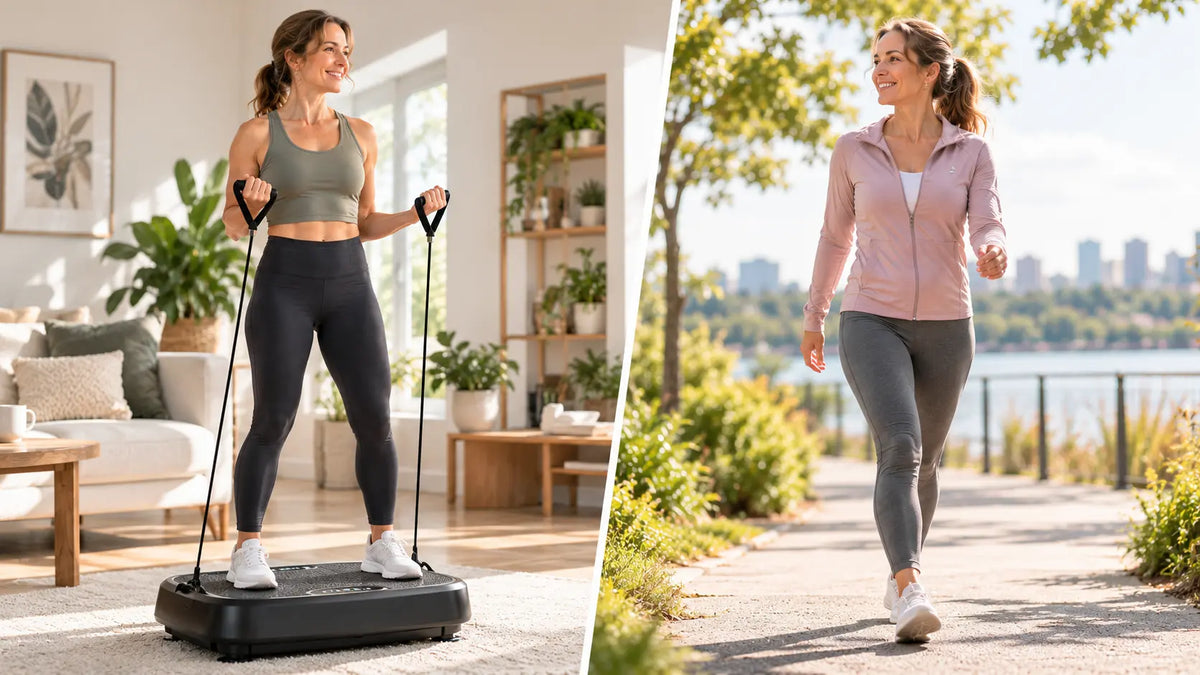
Walking and a vibration plate can both add movement to your day, but they are not the same type of exercise. Walking is an active, weight-bearing activity that can build aerobic activity into your day, while a vibration plate creates mechanical vibration that your body responds to while you stand or perform simple exercises. In a vibration plate vs walking comparison, walking remains the better foundation for general physical activity when it is practical and comfortable. A vibration plate can be a convenient complement when you want a compact, low-impact home option or a short movement break that is easy to fit into a busy routine.
Key Takeaways
- Walking and vibration training work differently. Walking requires you to move your body through space; a vibration plate provides mechanical vibration while you maintain a position or exercise on the platform.
- Walking is the stronger foundation for everyday aerobic activity. It is accessible, requires little equipment, and can contribute to overall physical activity.
- A vibration plate is useful for convenience. It can fit into short home routines when weather, space, schedule, or personal preference makes a walk less convenient.
- You do not necessarily have to choose one. For many people, the practical solution is walking when possible and using a vibration plate as another way to stay consistent with movement at home.
- Neither option needs to be extreme. A sustainable routine that matches your ability and schedule is more useful than chasing maximum speed or intensity.
 Vibration Plate vs Walking: What Is the Main Difference?
The simplest difference is how your body is being challenged.
During walking, you repeatedly step forward, support your body weight, and propel yourself through space. Your legs, hips, core, balance systems, and cardiovascular system all contribute as you continue moving.
On a vibration plate, you stay on a powered platform that produces repeated mechanical vibrations. Your muscles respond as you maintain your posture or perform movements such as shallow squats, calf raises, or exercises with resistance bands.
That makes vibration training a different movement stimulus rather than a shortcut version of walking. Research on whole-body vibration has examined outcomes such as muscle performance, balance, and physical function, including in older adults, but protocols vary substantially between studies. It should therefore be viewed as one fitness tool rather than a direct substitute for all of the activity you get from walking.
| Factor | Walking | Vibration Plate |
|---|---|---|
| Movement type | Active locomotion | Mechanical vibration plus standing or exercise |
| Aerobic activity | Can provide moderate-intensity aerobic activity depending on pace and individual effort | Should not automatically be considered equivalent to a walk |
| Space needed | Outdoor route, indoor space, or treadmill | Small dedicated floor area |
| Weather dependent | Yes, when walking outdoors | No |
| Home convenience | Depends on available space or equipment | Designed for compact home routines |
| Routine style | Continuous movement | Short standing and exercise sessions |
| Beginner progression | Adjust pace, distance, terrain, and duration | Adjust speed setting, duration, stance, and exercise choice |
 Where Walking Has the Advantage
Walking has one major advantage: it is a familiar form of physical activity that can be done almost anywhere. A comfortable pair of shoes and a safe place to walk may be all you need.
It can also contribute directly to your overall aerobic activity. The CDC notes that regular physical activity provides important health benefits, and walking is one common way adults can become more active.
Walking may make more sense when your priorities include:
- building more active time into your day;
- getting outdoors;
- gradually increasing distance or pace;
- using an activity that requires little specialized equipment; or
- making aerobic movement a regular part of your weekly routine.
Walking also offers natural variety. You can take a relaxed walk around the neighborhood, walk indoors, increase your pace, choose hills, or simply add several short walks throughout the day.
Where a Vibration Plate Fits Better
A vibration plate becomes particularly practical when the biggest obstacle is not knowing that you should move, but finding a routine you will actually do.
There is no route to plan, and you do not need outdoor weather to cooperate. A compact platform can stay in a living room, bedroom, or home workout corner, making it easier to fit a short session around work, family responsibilities, or screen time.
A vibration plate may fit your routine well if you:
- prefer exercising at home;
- want a compact piece of fitness equipment;
- like short, structured movement sessions;
- want adjustable intensity without running or jumping;
- spend long periods sitting and want an easy movement break; or
- want another home-fitness option alongside walking and other exercise.
For beginners, the goal does not need to be high intensity. A comfortable stance, slightly soft knees, a lower setting, and simple controlled movements are a more sensible place to start. Our guide to how to use a vibration plate for beginners explains the setup in more detail.
Want to see what a home setup looks like?
Compare the compact models and adjustable options in the Hophorse vibration plates collection.
Compare Vibration Plates
 Can You Combine Walking and a Vibration Plate?
Yes. In fact, thinking of these options as complementary rather than competing makes more sense for many home users.
You might walk when you have enough time and the weather is comfortable, then use a vibration plate on a busy morning or during an evening at home. The plate can also become a short movement break on
Share:
Vibration Plate vs Walking: What’s the Difference?
Can You Sit on a Vibration Plate? Safe Beginner Guide