
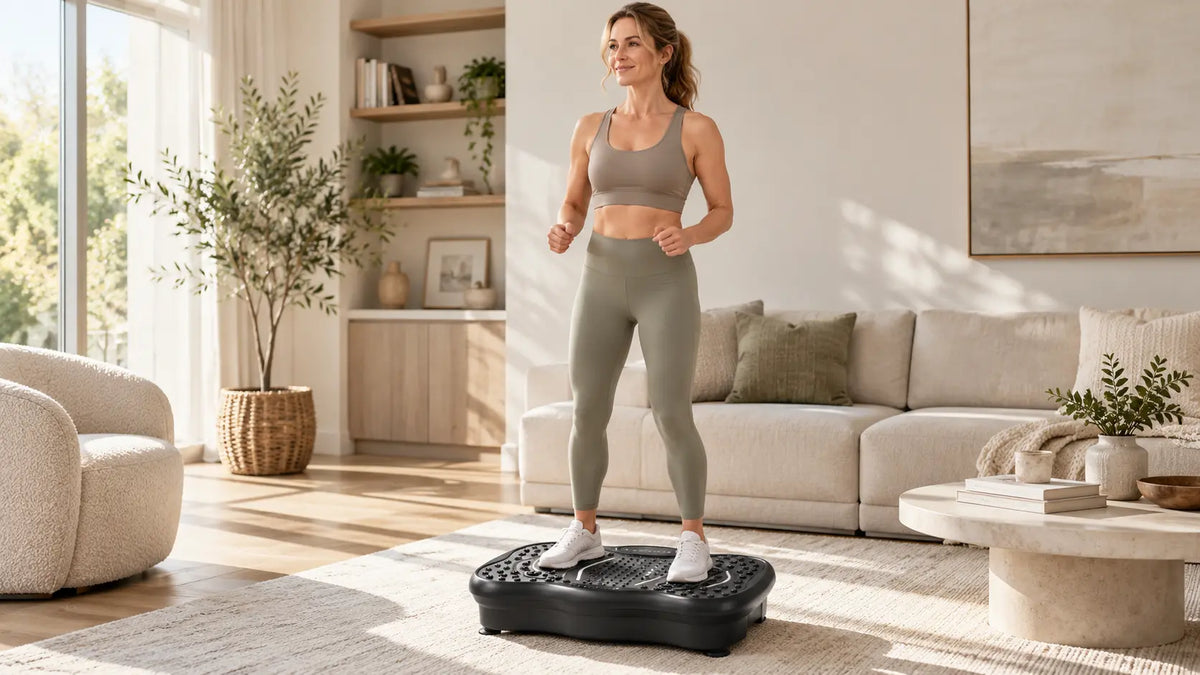
If you're new to vibration plates, the simplest way to choose a speed is to start at the lowest comfortable setting and increase gradually as you become familiar with the movement. A vibration plate speed levels chart can help you understand the difference between low, moderate, and higher settings, but the numbers aren't universal. Level 20 on one machine may feel different from level 20 on another.
This guide explains how vibration plate speeds work, gives you a practical beginner reference chart, and walks you through an easy 5–10 minute home routine. Whether you're adding movement after a long workday or creating a simple morning fitness habit, the goal is to find a setting that feels controlled, stable, and comfortable—not to reach the highest number.
Key takeaways
- Start with the lowest comfortable setting on your specific machine.
- Speed numbers are not standardized across vibration plate brands.
- Keep your knees slightly bent and your posture relaxed.
- Try a short session before adding time or intensity.
- Higher settings are not automatically better or more effective.
Beginner Vibration Plate Speed Levels Chart
Most home vibration plates use numbered settings to make vibration intensity easier to adjust. Some models have 99 levels, while others offer 180, 200, or even more. These numbers are control settings, not a standardized measurement of vibration frequency.
The chart below provides a general way to think about different intensity ranges on machines with a broad numbered scale. It is not a tested conversion chart or a recommendation to reach a particular number.
| General intensity | Illustrative level range* | Possible activities | What to focus on |
|---|---|---|---|
| Low | 1–30 | Familiarization, relaxed standing | Balance, posture, comfort |
| Low to moderate | 31–60 | Gentle knee bends or calf raises | Slow, controlled movement |
| Moderate | 61–100 | More active standing movements | Consistent form and stability |
| Higher | 101+ | Model-appropriate advanced routines | Careful progression and control |
*Illustrative categories only. These numerical ranges are not validated intensity thresholds and do not apply equally to every model. Always follow your product manual. Beginners do not need to progress through every range.
If your vibration plate has 99 levels, the chart's higher numerical ranges won't apply. If it has 200 or 300 levels, the additional settings may offer smaller adjustments or a different control scale. They don't necessarily mean that the machine produces proportionally stronger vibration.
Beginner tip: Treat speed numbers as a way to make small adjustments on your own machine—not as a score you need to improve. A low setting you can use comfortably is more useful than a high setting that disrupts your balance.
What Do Vibration Plate Speed Settings Actually Mean?
A vibration plate creates repeated platform movement while you stand or perform supported exercises. The controls let you change how the machine operates, but the word "speed" can be misleading.
Three concepts are worth understanding:
- Speed level: The numbered setting shown on the machine's display or remote control.
- Frequency: How many vibration cycles occur per second, measured in hertz (Hz).
- Amplitude: The distance the platform moves during vibration, typically described in millimeters.
A speed level is not automatically the same thing as frequency. For example, a display reading of 30 does not necessarily mean 30 Hz. The relationship depends on the motor, vibration mechanism, and manufacturer's controls.
Different platforms may also use different types of movement. That's why comparing two machines by their maximum speed number alone doesn't tell you exactly how they will feel.
When comparing Hophorse vibration plates, look at the adjustable controls, platform dimensions, available programs, and your intended home routine. A wider selection of levels can make adjustments more flexible, but more settings don't automatically make a machine more suitable for everyone.
What Speed Should Beginners Start With?
For a first session, begin at the lowest available setting that your product manual recommends for standing use. Spend a short period getting used to the sensation before deciding whether to increase it.
There is no single best numerical speed for every beginner. Your comfort, balance, experience, and the specific machine matter more than a number from an online chart.
How to find your starting setting
- Prepare the space. Place the vibration plate on a firm, level surface with enough room around it.
- Check the controls. Review your model's manual and select manual mode if appropriate.
- Step on while stopped. Position your feet securely on the platform as instructed.
- Keep your knees soft. Stand upright with a slight knee bend instead of locking your legs.
- Begin at the lowest setting. Notice how the vibration feels before making any adjustments.
-
Increase only if comfortable. Change one setting at a time while maintaining steady posture.

You should be able to breathe normally, remain steady, and stop the session without difficulty. If the movement feels too strong, lower the setting or end the session. Stop immediately if you experience dizziness, discomfort, or difficulty maintaining balance.
Don't feel pressured to move up several levels each day. Familiarity and control are better reasons to progress than simply wanting a higher display number.
Vibration Plate Speed Settings for Common Exercises
Once you're comfortable standing on your vibration plate, you may want to add simple movements. Different exercises place different demands on your balance and coordination, so the same setting may not feel equally comfortable for every activity.
| Exercise | Starting approach | Form reminder |
|---|---|---|
| Standing | Lowest comfortable setting | Keep knees slightly bent |
| Gentle knee bends | Low, controlled intensity | Use a small, comfortable range |
| Calf raises | Low intensity after gaining confidence | Move slowly without bouncing |
| Resistance-band movements | Low setting after mastering standing | Use only approved attachments |
| Advanced positions | Only as permitted by the manual | Prioritize technique over intensity |
These are movement suggestions rather than exact speed prescriptions. For your first few sessions, simple standing may be enough. Adding more exercises is optional.
If your machine includes resistance bands, check the attachment points and instructions before use. Start by learning the movements without vibration, then consider combining them only when you feel confident and stable.
A Simple 5–10 Minute Vibration Plate Routine for Beginners
One advantage of compact home fitness equipment is that it can fit into a busy schedule. You don't need a complicated workout plan to begin building a movement habit.
Try this short routine if you're comfortable using your machine, your manual permits the movements, and you have no reason to avoid vibration exercise. You can shorten the session at any point.
| Time | Activity | Setting |
|---|---|---|
| 0–1 minute | Comfortable standing | Lowest comfortable level |
| 1–3 minutes | Relaxed standing with soft knees | Low and steady |
| 3–5 minutes | Optional gentle knee bends | Low, controlled level |
| 5–7 minutes | Optional slow calf raises | Low, comfortable level |
| 7–10 minutes | Optional relaxed standing | Return to a low level |
This is an optional routine template, not a required duration or medical recommendation. A first session may be shorter than five minutes. Follow your machine's session limits and stop whenever needed.
Make the routine fit your day
Some people prefer a short morning session before getting ready for work. Others use their vibration plate after spending hours at a desk or while enjoying a quiet evening at home.
Choose a time when you're not rushed, and give yourself room to focus on balance. If you're following along with a show or listening to music, make sure you can still pay attention to the machine.
For a more detailed walkthrough, read our guide on how to use a vibration plate, including setup, posture, and basic operation.
Looking for a simple home workout setup?
Explore compact vibration plates with adjustable settings and easy-to-use controls.
Explore Hophorse Vibration PlatesHow to Choose a Vibration Plate With Adjustable Speeds
If you're shopping for your first vibration plate, it's easy to focus on the number of speed levels. But a comfortable home workout depends on more than the maximum setting.
Consider how easy the controls are to understand, whether the platform provides enough room for your stance, and how conveniently the machine fits into your living space.
Comparing Hophorse models
Hophorse offers several home vibration plates with adjustable settings. The right choice depends on your preferred design, available space, and the type of routine you want to build.
| Model | Listed speed levels | Why consider it? |
|---|---|---|
| Hophorse Whole Body Vibration Plate | 180 | Practical everyday option with beginner-friendly controls and resistance bands |
| Hophorse SYC Vibration Plate | 300 | Compact home-friendly design with a broad selection of settings |
| Hophorse Pro Vibration Plate | 180 | Adjustable settings and convenient controls for home movement |
| Hophorse Pro Max Vibration Plate | 200 | Wider platform and listed 460 lb maximum user weight capacity |
Model specifications reflect listed product information and may change. Confirm the latest details, capacity limits, and operating instructions on each product page before purchasing.
For most beginners, the Hophorse Whole Body Vibration Plate is a practical starting point. Its adjustable controls make it possible to begin gently and explore different settings at your own pace.
If you prefer a wider platform and want more room to progress, the Hophorse Pro Max Vibration Plate may be a better fit. Its listed 460 lb capacity is a product specification, not an indication that higher-speed workouts are appropriate for every user.
Before choosing a model, check:
- Speed adjustment and preset program options
- Platform dimensions and available standing space
- Maximum user weight capacity
- Remote control and display readability
- Storage space and expected operating noise
- Included accessories and product instructions
Quiet operation and a compact footprint can be especially useful in apartments or shared living spaces. Keep in mind that actual noise can vary with the speed setting, flooring, and room conditions.
Vibration Plate Safety Tips for Beginners
Vibration plates may be a convenient addition to a home fitness routine, but they aren't suitable for everyone. The most important starting point is to understand your machine and recognize when to stop.
- Read the manual before your first session.
- Place the machine on a stable, level surface.
- Keep the area around the platform clear.
- Use stable footing and avoid locked knees.
- Stay at a comfortable setting rather than chasing higher speeds.
- Stop if you feel dizzy, unsteady, or uncomfortable.
- Wait until the platform stops before stepping off.
- Never exceed the model's stated weight capacity or session limits.

Important safety reminder
If you're a senior with balance or health concerns, are pregnant, have a pacemaker or another implanted medical device, have a heart condition, have a history or risk of blood clots, have severe osteoporosis, or have recently had surgery, consult a healthcare professional before use. This also applies if you have an existing medical condition or are unsure whether vibration exercise is appropriate for you.
Vibration plate exercise is not a substitute for medical care or an individualized exercise plan.
Beginners sometimes assume that increasing the speed will make a short workout more productive. In practice, losing control of your posture is a good reason to reduce intensity, not push through it.
Focus on creating a routine you can manage comfortably. Even a brief movement break can be a useful way to make space for physical activity during a busy day.
Frequently Asked Questions About Vibration Plate Speed Levels
1. What is the best vibration plate speed for beginners?
The best starting speed is the lowest comfortable setting recommended for your machine. Begin with a short session, keep your knees slightly bent, and increase gradually only when you feel stable.
2. What does level 30 mean on a vibration plate?
Level 30 is a numbered control setting, not necessarily a frequency of 30 Hz. Its actual intensity depends on the model, motor, and vibration mechanism. Check your product manual for details.
3. Is a higher vibration plate speed better?
Not necessarily. Higher speeds can feel more intense, but they are not automatically more effective. A comfortable setting that allows steady posture and controlled movement is a better starting point.
4. How long should beginners use a vibration plate?
Start with a short session, potentially less than five minutes, and follow your machine's instructions. As you become comfortable, a 5–10 minute routine may be an option if it is within the manufacturer's recommended limits.
5. Are 200 speed levels better than 99 speed levels?
Not automatically. More levels may provide finer adjustment, but speed scales differ between machines. Compare platform stability, controls, dimensions, and operating instructions rather than speed count alone.
6. Can seniors use a vibration plate at low speed?
Some older adults may be able to use a vibration plate, but suitability depends on individual health, balance, and mobility. Seniors with health or balance concerns should consult a healthcare professional before use.
7. Can I use a vibration plate every day?
Daily use may be appropriate for some people, depending on the machine's instructions, session length, and individual tolerance. Start gradually, allow time for rest when needed, and avoid increasing intensity too quickly.
8. How do I know when to increase my vibration plate speed?
Consider a small increase only when your current setting feels comfortable and you can maintain steady posture throughout the session. If your balance or form changes, return to a lower setting.
Find a Comfortable Starting Point
A vibration plate speed levels chart is most useful when it helps you make thoughtful adjustments—not when it encourages you to reach a particular number. Start low, learn your machine, and choose movements that feel steady and manageable.
Whether you have five minutes before work or a little time in the evening, a simple home routine can make daily movement easier to fit into your schedule.
Explore your options for home movement.
Compare Hophorse vibration plates to find the platform size, controls, and features that suit your space and routine.
Shop Hophorse Vibration PlatesEditorial note: This guide provides general fitness information and is not medical advice. Speed settings and specifications vary by model. Always follow the instructions supplied with your vibration plate.
Share:
Best Vibration Plate for Beginners: What to Look For Before Buying
Best Compact Vibration Plate for Small Spaces