
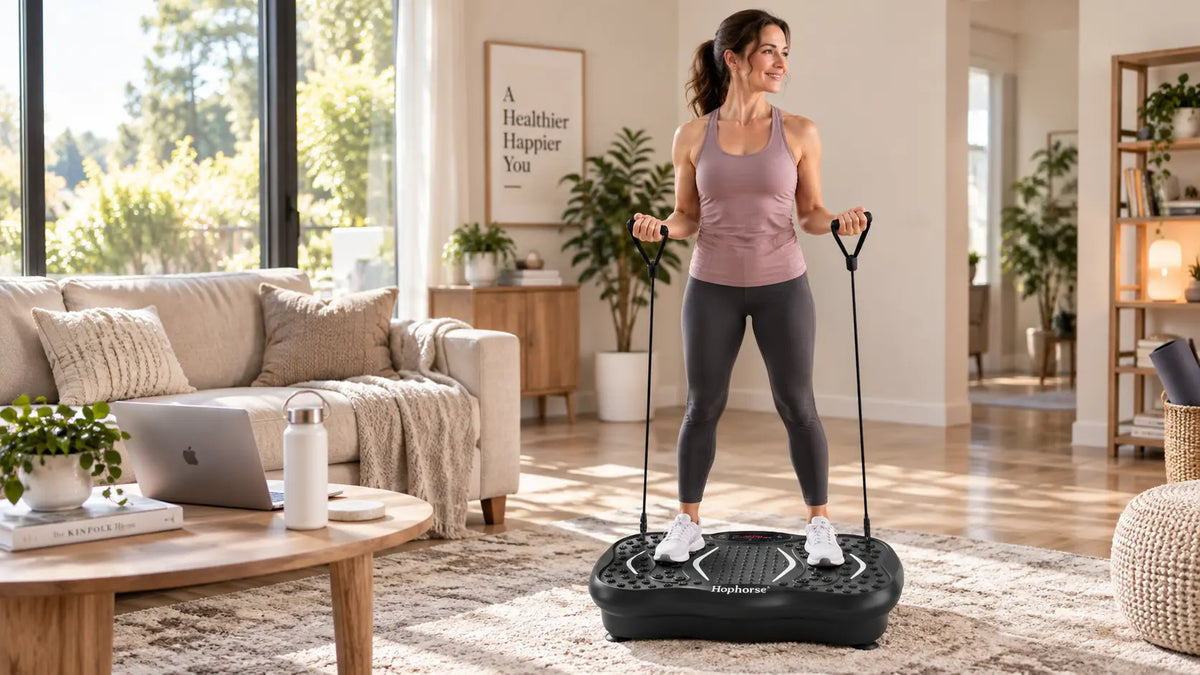
If you spend most of your workday at a desk, in the car, or moving between long periods of sitting, fitting more movement into the day does not have to mean committing to a full workout. A vibration plate can provide a simple way to add short periods of low-impact movement at home. For beginners, even a 5–10 minute routine can be an approachable starting point. The key is not making the routine intense—it is making it easy enough to repeat. Below, we break down a practical 10-minute vibration plate routine for people who sit all day, along with beginner tips, exercise ideas, and ways to choose a plate that fits your home and schedule.

Why Add Movement After a Day of Sitting?
For many people, sitting is simply part of modern life. You may spend hours working at a computer, commuting, watching TV, or taking care of tasks that keep you in one position. The challenge is often not knowing that movement is useful—it is finding a realistic way to make movement happen consistently.
Instead of thinking only in terms of traditional workouts, it can help to think about creating small movement opportunities throughout your day. A few minutes before work, during a break, or after you close your laptop may feel much more manageable than scheduling another 45-minute workout.
A vibration plate for people who sit all day can fit this approach because it requires little setup and can stay in a bedroom, living room, or dedicated home workout corner. Step on, choose a comfortable setting, move for a few minutes, and then continue with your day.
 Why Use a Vibration Plate in a Home Movement Routine?
A vibration plate creates rapid platform movement while you stand or perform simple exercises on it. Your muscles respond to the changing platform position as you maintain your posture and perform movements such as shallow squats or calf raises.
For home users, the practical advantage is simplicity. You do not need a large workout area, complicated setup, or a long training session. That can make vibration training especially appealing to beginners and people whose biggest obstacle is finding time to move.
| Feature | Why It Matters at Home |
|---|---|
| Compact footprint | Easier to keep in a bedroom, living room, or small workout space. |
| Adjustable speeds | Lets beginners start conservatively and adjust gradually. |
| Stable platform | Provides room for simple standing exercises and movement. |
| Quiet operation | Better suited to shared homes and everyday indoor use. |
| Short sessions | Makes movement easier to fit around work and daily responsibilities. |
 A Simple 10-Minute Vibration Plate Routine After Sitting
This routine is designed to be straightforward rather than exhausting. If you are new to vibration training, start at a comfortable low setting and focus on stable posture and controlled movement. You can also shorten individual steps or take breaks as needed.
Minutes 0–2: Comfortable Standing
Stand near the center of the plate with your feet comfortably apart. Keep your knees slightly bent rather than locked, relax your shoulders, and maintain an upright posture.
Use these first two minutes to become familiar with the platform. Beginners should choose a lower setting that feels manageable rather than immediately increasing the speed.
Minutes 2–4: Gentle Weight Shifts
Keep both feet on the platform and slowly shift a small amount of weight from one side to the other. The movement should remain controlled. Avoid leaning dramatically or trying to turn this into a balance challenge.
This is an easy transition from simply standing to actively participating in the session.

Minutes 4–6: Shallow Squats
From a stable standing position, bend your knees slightly and move your hips back into a shallow squat. Return slowly to your starting position and repeat at a comfortable pace.
You do not need a deep squat. Keep the range of motion appropriate for your current mobility and experience.
Minutes 6–8: Calf Raises
Stand tall with soft knees. Slowly raise your heels, pause briefly, and lower them again. If you need extra stability, position the plate near a sturdy support and follow the manufacturer's instructions for safe use.
Controlled repetitions are more important than trying to move quickly.
Minutes 8–10: Easy Standing Finish
Finish by returning to a comfortable standing position. Keep your knees slightly bent and allow the final two minutes to feel easy. This is not a test of how high you can set the machine.
When the session ends, step off carefully and give yourself a moment before moving on with your day.
| Time | Movement | Main Focus |
|---|---|---|
| 0–2 min | Comfortable standing | Get familiar with the plate |
| 2–4 min | Gentle weight shifts | Controlled movement |
| 4–6 min | Shallow squats | Lower-body muscle activation |
| 6–8 min | Calf raises | Slow, controlled repetitions |
| 8–10 min | Easy standing | Comfortable finish |
Looking for a simple home setup? Compare compact, adjustable options designed for convenient everyday movement.
Explore Hophorse Vibration Plates
Beginner Tips for a Better Routine
If you have been sitting most of the day, there is no need to turn your first vibration plate session into a demanding workout. Give yourself time to learn how the platform feels.
- Start low. Begin with a comfortable speed instead of immediately choosing a high setting.
- Keep your knees soft. Avoid standing with your knees rigid
Share:
Can You Sit on a Vibration Plate? Safe Beginner Guide
Vibration Plate for People Who Sit All Day: 10-Min Routine