
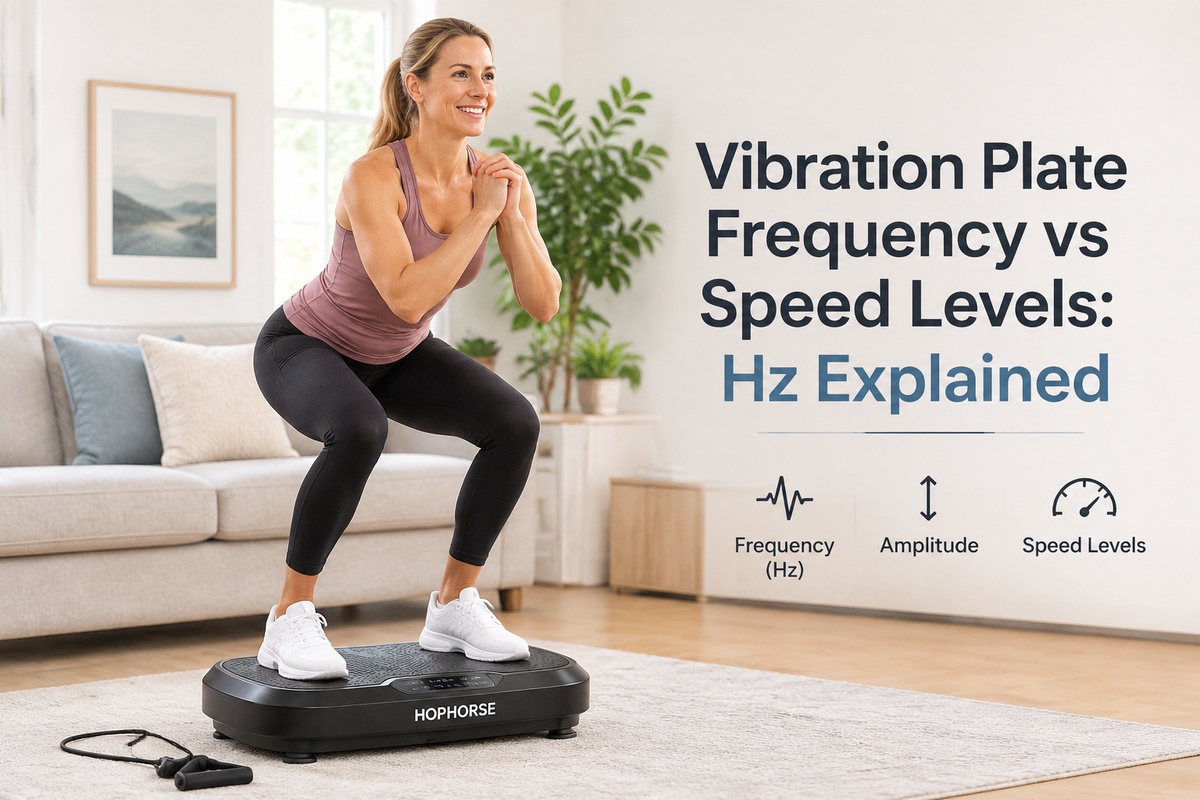
When shopping for a vibration plate, you may come across two specifications that sound similar: frequency (Hz) and speed levels. Are they the same thing? Not quite. Frequency measures how many vibration cycles occur per second, while speed levels are the adjustable settings a manufacturer provides on a particular machine. A plate with 180 speed levels does not necessarily vibrate at 180 Hz. Understanding this difference makes it easier to compare products, interpret technical specifications, and choose a comfortable setting for your home workout routine. Let's break down what Hz means, how adjustable speed works, and what else to consider before choosing a vibration plate.
 A simple home fitness routine starts with understanding your equipment.
1. What Does Frequency (Hz) Mean on a Vibration Plate?
Frequency describes how often a vibration repeats over a specific period. It is measured in Hertz (Hz), with one Hz representing one complete cycle per second.
For example:
- 1 Hz: One vibration cycle per second.
- 10 Hz: Ten vibration cycles per second.
- 20 Hz: Twenty vibration cycles per second.
- 30 Hz: Thirty vibration cycles per second.
In whole-body vibration research, frequency is one of several important variables used to describe how a platform operates. Other variables include vibration direction, magnitude or amplitude, and session duration.
When a manufacturer publishes a frequency specification, it tells you something about the physical vibration produced by the machine. This is more specific than simply knowing how many adjustment levels appear on its display.
Quick takeaway: Hz is a measurement of vibration frequency, not a product's number of speed settings. A vibration plate with 100 adjustable levels does not automatically operate at 100 Hz.
2. What Do Vibration Plate Speed Levels Mean?
Speed levels are the numbered settings available through a vibration plate's control panel or remote. They allow users to adjust the machine's operating intensity within the manufacturer's designed range.
For example, a product advertised with 180 speed levels provides 180 selectable settings. A different model with 200 levels offers a different number of adjustment steps.
These numbers are useful when comparing the control options available on different machines. However, they do not tell you the exact vibration frequency in Hz or how much physical movement the platform produces at each setting.
Think of speed levels as the controls on your equipment rather than a scientific measurement of vibration frequency.
Do more speed levels mean a stronger vibration?
Not necessarily. More levels may provide smaller adjustment increments or a wider range of selectable settings, but the number alone does not establish how powerful a machine is.
For a meaningful comparison, look at the manufacturer's published specifications, including frequency, amplitude, motor information, platform design, and operating instructions. If a manufacturer does not provide a particular measurement, avoid assuming it from the number of speed levels.
 Digital controls make it easier to select and adjust your preferred setting.
3. Vibration Plate Frequency vs Speed: What's the Difference?
The easiest way to understand vibration plate frequency vs speed is to separate the physical measurement from the machine's user controls.
| Specification | What It Measures | How to Read It |
|---|---|---|
| Frequency (Hz) | Number of vibration cycles per second | A physical vibration measurement |
| Speed levels | Available adjustable settings | How many settings users can select |
| Amplitude (mm) | Distance associated with the platform's vibration movement | A measurement of vibration displacement |
| Session duration | How long a session lasts | Usually measured in minutes |
These specifications describe different aspects of a vibration plate. They work together to help explain how a machine operates, but one cannot replace another.
For example, imagine comparing two products:
- Model A offers 180 adjustable speed levels.
- Model B offers 200 adjustable speed levels.
It would be reasonable to say that Model B provides more selectable settings. It would not be reasonable to conclude that Model B vibrates at a higher frequency, produces a stronger vibration, or delivers a better workout based on that number alone.
To compare the actual vibration characteristics, you would need verified technical measurements for both products.
Shopping tip: If a product listing only provides speed levels, treat that as an adjustable-control specification. Ask the manufacturer for the frequency in Hz if that measurement is important to your comparison.
4. What Is the Difference Between Frequency and Amplitude?
Frequency and amplitude are two separate measurements that are often discussed together when describing whole-body vibration.
Frequency tells you how often the vibration repeats. Amplitude describes the size of the vibration displacement, usually expressed in millimeters.
A simple way to remember the difference is:
- Frequency: How many vibration cycles happen each second?
- Amplitude: How far does the platform move during its vibration cycle?
For example, a manufacturer might specify a vibration frequency in Hz and an amplitude in millimeters. Both measurements are needed to describe the movement more completely.
When comparing amplitude specifications, check whether the manufacturer reports peak displacement or peak-to-peak displacement. These are not interchangeable measurements, and inconsistent reporting can make two products appear more similar or different than they really are.
 Frequency describes repetition, while amplitude describes displacement.
There is another important detail: vibration direction and platform design can also influence how movement is delivered. Two machines with similar frequency and amplitude figures may not feel identical in use.
That is why it is better to evaluate a complete set of specifications instead of choosing a vibration plate based on one impressive number.
5. What Should Beginners Look for When Choosing a Vibration Plate?
If you are new to vibration training, technical specifications can quickly become confusing. You do not need to understand every engineering detail before choosing a home fitness product. Start with the features that affect everyday usability.
1. Clear and adjustable controls
Look for controls that are easy to understand and allow you to make adjustments without complicated setup. A remote control and readable display can make everyday operation more convenient.
2. A suitable range of speed settings
Consider how many adjustment options are available and whether the controls allow you to find a comfortable starting point. Remember that a larger number of levels does not automatically mean better performance.
3. Stable platform construction
Platform size, surface texture, base construction, and floor contact are practical considerations. A non-slip surface and stable placement can make a home workout feel more comfortable and controlled.
4. Space and noise considerations
For apartment living or smaller rooms, consider the machine's dimensions, storage needs, and published noise information. Actual operating noise may vary depending on the floor, surface, speed setting, and environment.
5. Useful accessories
Some vibration plates include resistance bands, remote controls, or preset programs. These features can add convenience and provide more ways to incorporate movement into your routine.
 A compact setup can make it easier to fit movement into everyday life.
6. Comparing Hophorse Vibration Plates and Their Speed Levels
Hophorse offers several vibration plate models with different control configurations and features. The number of available speed levels varies by model, so it is worth checking the individual product specifications before making a decision.
| Hophorse Model | Published Speed Levels | Useful Features |
|---|---|---|
| Whole Body Vibration Plate ST | 180 | Resistance bands, remote control, 5 preset modes, compact design |
| Hophorse Pro Vibration Plate | 180 | LED display, remote control, Bluetooth, 5 preset modes |
| Hophorse Vibration Plate SYC | 300 | Manual and preset programs, resistance bands, compact design |
| Hophorse Pro Max Vibration Plate | 200 | 180W motor, 15mm published amplitude, reinforced platform, 5 preset modes |
These figures describe the published number of adjustable settings, not the actual frequency in Hz. The number of speed levels should not be used to calculate or estimate a model's vibration frequency.
Which model might suit your routine?
For most beginners: The Hophorse Whole Body Vibration Plate is a practical starting point. Its 180 adjustable speed levels, five preset modes, remote control, and included resistance bands offer a straightforward setup for everyday home movement.
For users interested in more adjustment options: The Hophorse Vibration Plate SYC offers 300 speed levels. This gives users more selectable settings, although it does not mean the machine operates at 300 Hz or necessarily vibrates more strongly.
For users who want additional platform support: The Hophorse Pro Max Vibration Plate offers 200 speed levels, a 180W motor, a published 15mm amplitude specification, and a reinforced platform.
Another option: The Hophorse Pro Vibration Plate combines 180 adjustable speed levels with five preset programs, an LED display, and Bluetooth connectivity.
Explore your home fitness options
Compare different platform designs, control options, and features to find a vibration plate that fits your space and routine.
Shop Hophorse Vibration Plates7. How Should Beginners Start Using a Vibration Plate?
Once you have selected a vibration plate, the next step is learning how to use its controls comfortably. You do not need to begin with the highest setting or try every available feature in your first session.
Here is a simple approach to getting familiar with your equipment:
- Read the user manual. Check the recommended operating instructions, safety information, and available programs for your specific model.
- Position the plate correctly. Place it on a suitable, level surface and check that it is stable before use.
- Start with a low setting. Choose a gentle starting level rather than immediately selecting a higher intensity.
- Maintain a comfortable position. Stand with your feet securely placed on the platform and keep your knees slightly relaxed if the instructions permit.
- Keep your first session short. Follow the manual's guidance and give yourself time to become familiar with the sensation.
- Adjust gradually. Change one setting at a time and stop if you experience discomfort, dizziness, or unusual symptoms.
 Start with the instructions, a comfortable position, and a manageable setting.
Can you use a vibration plate as part of a daily routine?
A vibration plate can be one part of a broader home fitness routine. Some people use it during a short movement break, while others incorporate light squats, standing exercises, or resistance-band movements according to the equipment instructions.
You can also combine it with walking, stretching, and other forms of physical activity. A vibration plate should not be treated as a replacement for a balanced exercise routine.
Remember: Consistency and comfort are more useful starting points than chasing the highest speed level. Choose a routine that fits your experience, equipment instructions, and personal comfort.
8. Safety Considerations Before Using a Vibration Plate
Whole-body vibration is not suitable for everyone. Before starting, read the manufacturer's safety instructions and consider your individual circumstances.
If you are pregnant, have a pacemaker, have recently undergone surgery, have a heart condition, have a risk of blood clots, or have severe osteoporosis, consult a healthcare professional before use. Seniors and anyone with an existing medical condition, balance concerns, or uncertainty about vibration training should also consult a healthcare professional before use.
Do not assume that a lower speed setting makes vibration training appropriate for every person. Stop using the machine if you experience discomfort, dizziness, or other unusual symptoms, and seek appropriate professional guidance.
For everyday home use, follow the specific product manual, use the machine on a suitable surface, and avoid exceeding the manufacturer's recommended session duration.
9. Frequently Asked Questions
1. Is vibration plate frequency the same as speed?
No. Frequency is measured in Hz and describes the number of vibration cycles per second. Speed levels are adjustable settings provided by the manufacturer. They are different measurements and cannot be directly substituted for one another.
2. What does 180 speed levels mean on a vibration plate?
It means the machine offers 180 selectable speed settings. It does not mean the vibration frequency is 180 Hz. Check the manufacturer's specifications for a separately published frequency measurement.
3. Does a vibration plate with 200 levels work better than one with 180 levels?
Not necessarily. A higher number of levels means more selectable settings, but it does not automatically indicate stronger vibration, higher frequency, or better workout performance. Compare the full product specifications and features instead.
4. What is a good vibration plate frequency for beginners?
There is no single frequency that is right for every beginner. Frequency, amplitude, vibration direction, session duration, and individual circumstances all matter. Choose equipment with clear manufacturer specifications and follow its operating instructions.
5. Can I calculate Hz from the speed level on my vibration plate?
No. A speed level does not provide enough information to calculate the actual vibration frequency. Ask the manufacturer for verified Hz specifications if you need to know the machine's operating frequency.
6. Is amplitude more important than frequency?
Neither measurement should be considered in isolation. Frequency describes vibration cycles per second, while amplitude describes displacement. Both, along with vibration direction and other operating variables, help describe how a vibration plate works.
7. Are Hophorse vibration plates measured in Hz?
Hophorse product listings publish adjustable speed levels for individual models, including 180, 200, and 300-level configurations. These published settings should not be interpreted as Hz values. Contact Hophorse support if you need a verified frequency specification for a particular model.
8. What should I check before buying a vibration plate?
Look at adjustable settings, published frequency and amplitude specifications, platform stability, dimensions, noise information, controls, included accessories, and the manufacturer's safety guidance. Compare the complete specifications rather than relying on one number.
Final Thoughts: Look Beyond the Numbers
Understanding vibration plate frequency vs speed makes shopping much easier. Hz describes how many vibration cycles happen per second, while speed levels describe the settings available on a particular machine. Amplitude adds another piece of information by describing the platform's displacement.
When comparing vibration plates, look for clear specifications, practical controls, a stable platform, and features that suit your home and fitness routine. More speed levels do not automatically mean better performance, and a higher number should never be mistaken for a frequency measurement.
For beginners, a simple and comfortable setup can be a sensible place to start. Explore the different Hophorse vibration plates and compare their features to find an option that fits your everyday movement goals.
Make room for more everyday movement.
Discover compact vibration plates designed to fit naturally into your home fitness routine.
Explore Hophorse Vibration PlatesThis article is for general educational purposes only and is not a substitute for medical advice. Always follow the user manual and consult a healthcare professional if you are unsure whether vibration training is appropriate for you.
Share:
Hophorse vs MERACH Vibration Plate: Features, Stability & Value
Can You Use a Vibration Plate on Carpet? Flooring & Safety Guide