
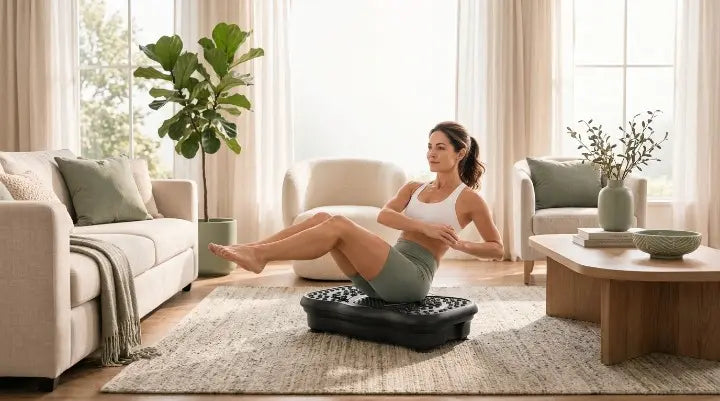
Vibration Plate Exercise Guide
If you are looking for the best positions on a vibration plate, start simple. For most beginners, the best position is standing with your feet about shoulder-width apart, knees slightly soft, and posture relaxed. Once you feel comfortable, you can add beginner-friendly movements such as calf raises, soft knee bends, resistance band pulls, or supported squats.
Quick answer: The best vibration plate positions for beginners are basic standing, soft knee bends, calf raises, seated position, and light resistance band pulls. More advanced users may add squats, planks, lunges, and single-leg balance work. Start with simple positions first, keep your session short, and focus on control rather than intensity.
This guide explains which vibration plate positions are best for beginners, how to do each one safely, what each position is best for, and how to build a simple routine at home. If you are still choosing a machine, you can compare Hophorse vibration plates designed for low-impact home workouts.
Key Takeaways
- Beginners should start with standing, soft knee bends, and calf raises.
- Keep your knees slightly soft instead of locked while standing on the platform.
- Squats, planks, and lunges are more advanced and require better balance.
- Changing positions can make your routine feel more complete and less repetitive.
- Form and control matter more than using the highest vibration level.
- Stop if you feel dizzy, unstable, numb, or uncomfortable.
Best Vibration Plate Positions Chart
Different vibration plate positions can support different goals. Some positions are better for first-time users, while others require more control, balance, or upper-body strength.
| Position | Best For | Difficulty | Beginner Tip |
|---|---|---|---|
| Basic standing | First-time use, warm-up, daily movement | Easy | Keep knees slightly soft and stand tall. |
| Soft knee bends | Lower-body engagement | Easy | Use small controlled bends, not deep squats. |
| Calf raises | Lower-leg movement and balance | Easy to moderate | Move slowly and hold support if needed. |
| Seated position | Gentle lower-body use | Easy | Sit upright and keep the level comfortable. |
| Squat position | Legs, glutes, and active routines | Moderate | Start with a shallow squat and short sets. |
| Plank position | Core and upper-body control | Moderate to advanced | Keep sessions short and maintain alignment. |
| Lunge position | Single-leg control and lower-body work | Advanced | Use support and keep the movement controlled. |
| Single-leg stand | Balance practice | Advanced | Only try after you are comfortable on two feet. |
If you are not sure how long to hold each position, read our guide on how long to stand on a vibration plate.
How Many Vibration Plate Positions Should You Do?
Most beginners do not need a long list of exercises. A simple routine with 3–5 positions is usually enough to start. Focus on positions that feel stable and easy to repeat.
Beginner rule: Start with basic standing, soft knee bends, and calf raises before trying planks, lunges, or single-leg balance positions.
A good beginner session may include:
- 1–2 minutes of comfortable standing
- 2 minutes of soft knee bends
- 2 minutes of calf raises
- 2 minutes of light resistance band pulls
- 1–2 minutes of relaxed standing to finish
If your session starts to feel uncomfortable or your posture breaks down, stop or reduce the level. More positions are not always better.
Beginner-Friendly Vibration Plate Positions
These positions are the best place to start if you are new to vibration plate training. They are simple, controlled, and easier to fit into a short home routine.
1. Basic Standing Position
This is the most common starting point and one of the best vibration plate positions for beginners. It helps you get used to the platform before adding movement.
```- Stand with feet about shoulder-width apart.
- Keep your knees slightly soft.
- Relax your shoulders and stand tall.
- Hold support if needed.
- First-time use
- Warm-ups
- Daily movement breaks
- Learning balance and posture
2. Soft Knee Bend Position
Soft knee bends are a small step up from standing. They add gentle lower-body engagement without requiring a deep squat.
```- Stand with feet stable on the platform.
- Bend your knees slightly.
- Keep your chest lifted.
- Move slowly and stay controlled.
- Beginners
- Lower-body engagement
- Short daily routines
- Building confidence before squats
3. Calf Raises
Calf raises are a simple way to add movement without making the session too complicated. They can also make a short routine feel more active.
```- Stand with both feet on the platform.
- Slowly lift your heels.
- Lower back down with control.
- Hold support if balance feels challenging.
- Lower-leg movement
- Balance practice
- Beginner-friendly active sessions
- Short 5–10 minute routines
4. Seated Position
The seated position is a gentler option that some users prefer for lower-intensity sessions. Keep the level comfortable and avoid leaning back too much.
```- Sit carefully on the edge of the platform.
- Keep your feet on the floor.
- Sit upright with relaxed shoulders.
- Use a low, comfortable level.
- Gentle sessions
- Lower-intensity use
- Users who want a relaxed position
- Short movement breaks
Intermediate Vibration Plate Positions
Once you feel comfortable with beginner positions, you can gradually add more active movements. Keep your settings controlled and focus on form.
5. Squat Position
Squats are one of the most popular vibration plate exercises because they involve the lower body and core. Start with a shallow squat rather than a deep squat.
```- Stand with feet slightly wider than shoulder-width.
- Lower into a shallow squat.
- Keep your chest lifted.
- Keep your knees tracking comfortably.
- Lower-body routines
- Glutes and thighs
- More active home workouts
- Users comfortable with basic standing
Start with short sets, such as 20–30 seconds, and rest as needed.
```6. Resistance Band Pulls
If your vibration plate includes resistance bands, you can use them for light upper-body movement while standing on the platform.
```- Stand comfortably on the platform.
- Hold the resistance bands with both hands.
- Use slow, controlled pulls.
- Keep your core engaged and shoulders relaxed.
- Upper-body movement
- Short full-body routines
- Adding variety
- Beginner-to-intermediate users
When using bands, start with a lower vibration level so your balance stays controlled. For more help, see our guide on what vibration plate level to use.
```7. Plank Position
Planks can make a vibration plate routine more challenging because they require upper-body and core control. This position is better for users who already feel comfortable with the machine.
```- Place your hands or forearms on the platform.
- Step your feet back carefully.
- Keep your body in a straight line.
- Hold only as long as you can keep good form.
- Core engagement
- Upper-body control
- Short intervals
- Intermediate users
Advanced Vibration Plate Positions
These positions are not necessary for beginners. Try them only after you feel stable with basic standing, knee bends, calf raises, and light squats.
8. Lunge Position
Lunges require more balance because one leg is placed differently from the other. Start carefully and use support if needed.
```- Place one foot on the platform.
- Step the other foot back onto the floor.
- Bend the front knee slightly.
- Keep your movement slow and controlled.
- Advanced lower-body routines
- Single-leg control
- Balance practice
- Short, controlled sets
9. Single-Leg Stand
Single-leg standing is one of the most challenging vibration plate positions because it requires balance and control. This is not recommended for first-time users.
```- Stand on the platform with both feet first.
- Shift your weight slowly to one foot.
- Lift the other foot only slightly if stable.
- Keep the set short and controlled.
- Advanced balance practice
- Core control
- Ankle stability
- Experienced users only
How to Choose the Right Vibration Plate Position
The best position depends on your experience level and what you want from the session. For most beginners, the best choice is not the hardest position. It is the position you can do with good control.
| Your Goal | Best Starting Position | What to Avoid at First |
|---|---|---|
| First-time use | Basic standing | High levels or single-leg balance |
| Low-impact daily movement | Standing, knee bends, calf raises | Long sessions or deep squats |
| Lower-body engagement | Soft knee bends, supported squats | Fast movement or poor posture |
| Core-focused routine | Short plank intervals | Holding a plank after your form breaks down |
| Balance practice | Calf raises or supported stance | Single-leg work before you are ready |
A Simple 10-Minute Beginner Routine
You do not need a complicated routine to get started. This simple structure uses beginner-friendly positions and keeps the session easy to follow.
| Time | Position | Focus |
|---|---|---|
| 0–2 minutes | Basic standing | Get comfortable with the platform. |
| 2–4 minutes | Soft knee bends | Add gentle lower-body movement. |
| 4–6 minutes | Calf raises | Add controlled lower-leg movement. |
| 6–8 minutes | Resistance band pulls | Add light upper-body movement. |
| 8–10 minutes | Relaxed standing | Finish comfortably. |
If you are new, keep the vibration level low and focus on staying stable. You can gradually add more positions once the basic routine feels easy.
Common Mistakes to Avoid
Many beginners make vibration plate workouts harder than they need to be. Avoid these mistakes to keep your routine safer and easier to repeat.
- Locking your knees: Keep knees slightly soft during standing positions.
- Starting too high: Use a lower level while learning the machine.
- Doing too many positions: Start with a few simple movements instead of a long routine.
- Ignoring posture: Stop if your form breaks down.
- Holding planks too long: Keep advanced positions short and controlled.
- Using the machine as a shortcut: Consistency and proper form matter more than intensity.
Looking for a vibration plate for beginner-friendly positions?
Explore Hophorse vibration plates designed for compact home spaces, low-impact movement, adjustable speeds, and simple daily routines.
Shop Hophorse Vibration PlatesRecommended Hophorse Vibration Plates
The right vibration plate should feel stable, easy to control, and practical for the positions you want to do. If you are a beginner, start with a model that supports short standing routines and simple resistance band movement.
Safety Tips for Vibration Plate Positions
Vibration plates are simple to use, but different positions require different levels of control. Start with the easiest positions first, use a comfortable speed level, and stop if you feel dizzy, unstable, numb, or uncomfortable.
- Keep knees slightly soft during standing positions.
- Use a lower level when trying a new position.
- Hold support if balance feels difficult.
- Keep advanced positions short.
- Do not use maximum intensity during your first sessions.
- Follow your product manual for your specific machine.
Do not use a vibration plate without medical guidance if you are pregnant, have a pacemaker, have serious heart conditions, blood clot risks, recent surgery, epilepsy, severe osteoporosis, or any medical concern that could make vibration training unsafe for you.
When unsure, consult a healthcare professional before use.
Frequently Asked Questions
What are the best positions on a vibration plate?
The best vibration plate positions for beginners are basic standing, soft knee bends, calf raises, seated position, and light resistance band pulls. More advanced users may add squats, planks, lunges, and single-leg balance work.
What is the best vibration plate position for beginners?
Basic standing with knees slightly soft is usually the best starting position. It helps you learn the platform, maintain balance, and get comfortable before adding movement.
How many vibration plate positions should I do per workout?
Most beginners can start with 3–5 positions per session. A simple routine may include standing, soft knee bends, calf raises, resistance band pulls, and relaxed standing to finish.
Are squats good on a vibration plate?
Squats can be useful once you feel comfortable with basic standing. Start with shallow, controlled squats and keep sets short. Avoid deep squats or high intensity if you are new.
Can beginners do planks on a vibration plate?
Planks are more challenging and are better for users who already have good control. Beginners should start with standing positions first, then add planks later if they can maintain proper form.
What vibration plate level should I use for different positions?
Start with a low level when learning any new position. Use lower settings for standing, bands, planks, and balance work until you feel stable. You can read more in our guide on what vibration plate level to use.
Which Hophorse vibration plate is best for beginner positions?
For most beginners, the Hophorse Whole Body Vibration Plate is a practical starting point. If you want higher support and more room to progress, the Hophorse Pro Max Vibration Plate may be a better fit.
The Bottom Line
The best positions on a vibration plate are the ones you can perform with good control, steady balance, and proper form. For beginners, start with basic standing, soft knee bends, calf raises, and light resistance band movement before progressing to squats, planks, lunges, or single-leg balance positions.
A vibration plate does not need to be complicated. A short, consistent routine with simple positions can be easier to repeat and more useful than trying too many advanced exercises too soon.
Compare Hophorse Vibration Plates
Share:
Whole Body Vibration Plate Reviews: An Honest Buyer’s Guide
Purpose of Vibration Plate: What Is It Really Used For?